Intuition
Measure the two spins of a singlet along directions and at angle . Each result alone is a coin toss, but the mean of their product is : always opposite at , unrelated at , always equal at . The probability that the two agree is . It follows from letting ’s result fix ’s state. A simple local model, in which each pair carries a random direction and each spin answers by the side of it its axis lies on, gives a straight line instead of the cosine. They agree at 0, and , and nowhere else; the next lesson turns that gap into Bell’s test.
Two dancers mirror each other perfectly when they face the same way. Turn one of them and the mirroring fades — not by a fixed amount per degree, but along a smooth curve, strong for small angles. The cosine is that fading.
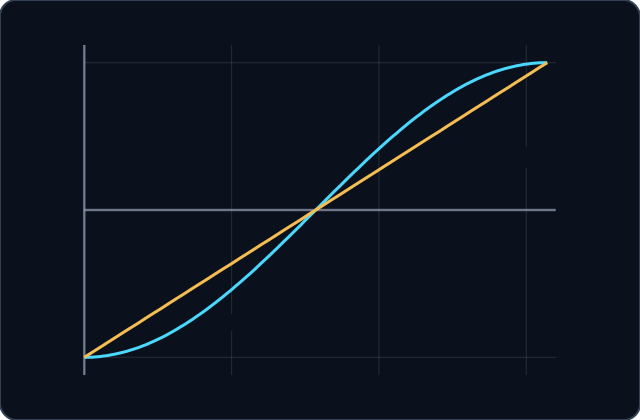
The mean product of the two results against the angle between the axes, for from 0 to : for the singlet, and the straight line of a local model with random directions. They meet at 0, and ; in between the quantum curve is the stronger correlation.
The singlet correlation
Spin measured along and spin along , at angle , each giving :
Properties
- Each result alone is with probability : on either side.
The singlet correlation
Take ’s result first: each value comes with probability one half. A result of along leaves down along , which is up along with probability ; a result of leaves up along , the mirror case. Averaging the product over the four cases gives the difference of and of the half angle, which is .
Proof steps
Spin alone is completely mixed.
As along , so along : the singlet has the same form along every axis.
points along , at angle from , and .
Products for equal, for opposite; is the mirror case.
.
Applications
Practice
The Cosine
For the singlet, the mean of the product of the two results is minus the cosine of the angle between the two axes.
Try it
The two axes are apart. What is for the singlet?
Each Side Alone Is Random
Spin of a singlet is completely mixed, so along any axis it gives or at random, half the time each, whatever does.
Try it
What does spin of a singlet give along any axis, looked at alone?
Unrelated at Right Angles
At 90° the cosine is zero: equal and opposite results are equally likely, and the product averages to nothing.
Try it
With the axes at , the results of the singlet are uncorrelated: .
Agreement
The probability that the two results agree is the square of the sine of half the angle between the axes.
Try it
The axes are 120° apart. What is the probability that the two spins give the same result?
Try it
The axes point in opposite directions, 180° apart. What do the two spins do?
Try it
The local model gives . What does it give at ?
Try it
For the singlet, depends on the directions of and and not only on the angle between them.
Final checkpoint
Try it
At , how does the quantum correlation compare with the straight-line local model?
Try it
can see the correlation in his own results, without ’s.
Try it
With both axes the same, , how often do the two spins agree?
Completion
Lesson complete
Great work! You now know how to:
- derive the singlet correlation
- compute the probability of agreement at any angle
- compare it with a simple local model