Intuition
Every linear map of the plane is decided by where it sends the two standard arrows, and a handful of kinds recur everywhere: turning, mirroring, flattening onto a line, stretching and sliding. Each is one small matrix, and its determinant says what it does to areas.
A slide projector can turn a picture, flip it, stretch it or throw its shadow onto a wall at an angle. Straight lines stay straight and the centre stays put, and those two facts are what make each of these a linear map.
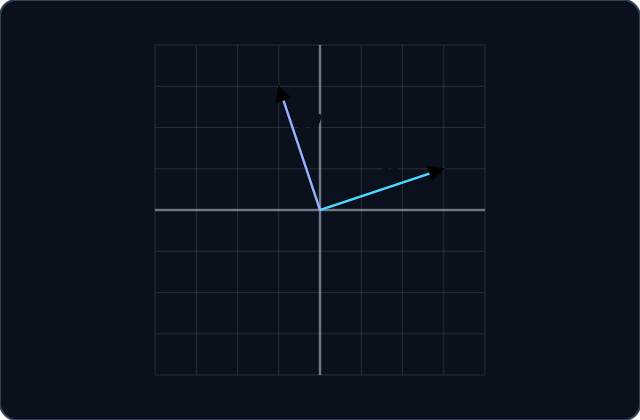
A quarter turn anticlockwise sends to : the length is kept and the two arrows meet at a right angle. It sends to and to , so its matrix is .
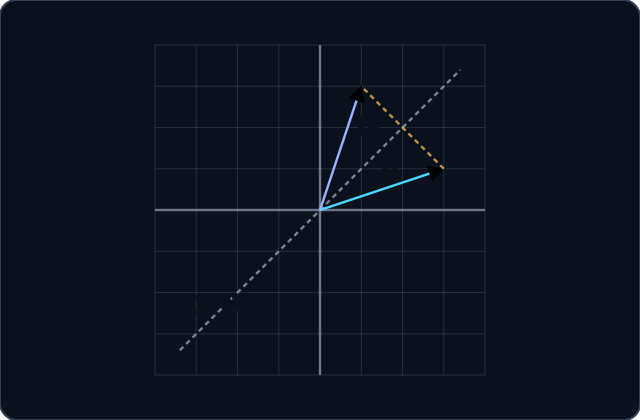
Reflection in the line swaps the two coordinates: goes to , and the dashed segment joining them crosses the mirror at a right angle. Its matrix has determinant : the map turns the plane over.
Five kinds of map
A linear map of the plane is the map of the matrix whose columns are and . It sends the unit square to the parallelogram on those two columns, so it multiplies every area by , and it turns the plane over when . The kinds below are the building blocks: every invertible map of the plane is a product of them.
Their matrices
- Rotation by the angle anticlockwise: above, with determinant .
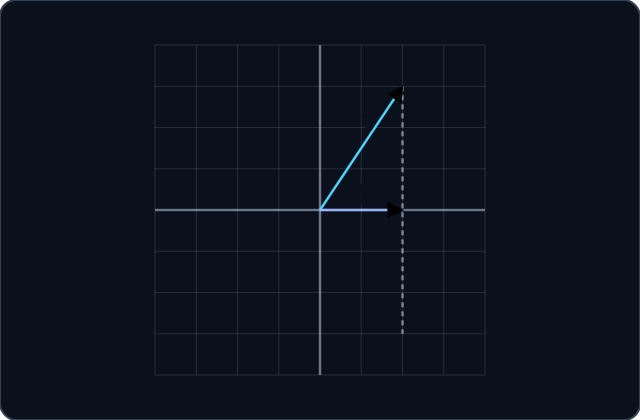
Projection onto the -axis keeps the first coordinate and drops the second: goes to . Every point of the dashed line lands on the same place, so the map cannot be undone, and its matrix has determinant .
The matrix of a rotation
A rotation about the origin is linear: turning a parallelogram turns its diagonal with it, and turning a stretched arrow gives the stretched turned arrow. So it has a matrix, whose columns are where and go. lands on the point of the unit circle at angle , which is by the definition of the cosine and sine; is a quarter turn further on.
Proof steps
Turning a parallelogram turns its diagonal with it, and turning a stretched arrow gives the stretched turned arrow: the rotation is linear, so it has a matrix.
is the point of the unit circle at angle . Turned by it is the point at angle , whose coordinates are the cosine and sine of by definition.
is the point at angle , so it lands at the angle .
A quarter turn sends a point to , so the point at angle is .
The images of the two standard vectors are the columns of the matrix.
Applications
Practice
Read the Columns
To find the matrix of a map of the plane, follow and . Their images, written as columns, are the matrix.
Try it
Which matrix turns the plane a half turn about the origin?
Try it
What does the matrix do to the plane?
Try it
A quarter turn anticlockwise about the origin sends to a point. What is its first coordinate?
Try it
Sliding every point of the plane two units to the right is a linear map.
Maps That Lose Information
Projection onto the -axis, , sends every point of a vertical line to one and the same point. Whole directions are crushed, so no map can undo it, and the unit square is flattened into a segment of area .
Try it
Which map of the plane has a matrix with determinant ?
Try it
The map of sends the unit square to a parallelogram. What is its area?
Try it
Reflecting in the -axis and then in the -axis is the same as which single map?
Try it
Every rotation of the plane about the origin has determinant 1.
Try it
Where does the shear send ?
What You Learned
- The columns of the matrix of a map of the plane are and .
- Rotation: , determinant . Reflection: determinant . Projection onto a line: determinant .
Final checkpoint
Try it
A linear map of the plane sends to and to . What does it do?
Try it
The rotation by anticlockwise has matrix . What is the second coordinate of the image of ? Give a decimal.
Try it
Projecting onto the -axis twice gives the same result as projecting once.
Completion
Lesson complete
Great work! You now know how to:
- write the matrix of a map of the plane from where it sends the standard vectors;
- recognise rotations, reflections, projections, scalings and shears;
- use the determinant as the area factor and the sign of orientation;
- compose maps of the plane by multiplying their matrices.