Intuition
The same map looks different in different bases, and a well-chosen basis can make it look simple. Changing basis is a matter of translating coordinates in, doing the map, and translating back, and the three steps multiply into one matrix.
A problem posed in miles can be solved in kilometres: convert the data, solve, and convert the answer back. When the second system suits the problem better, the detour is the short way.
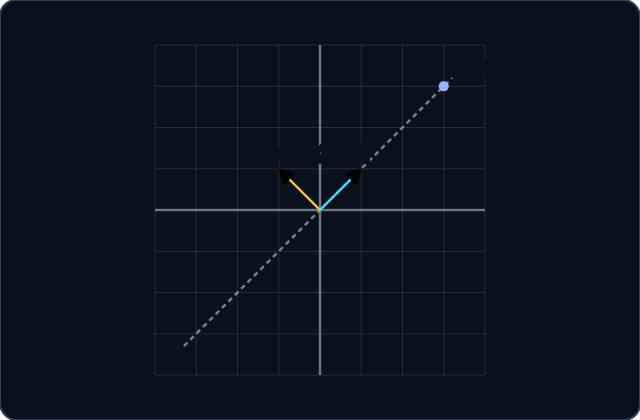
The map of in a basis fitted to it. It stretches along its own line to , and leaves where it is. In the basis its matrix is therefore .
Changing coordinates
Let be a basis of and the matrix with these vectors as columns. Then , so turns -coordinates into standard ones, and , which exists because the columns are a basis, turns them back. If is the map of , its matrix in the basis is . Matrices related in this way, for some invertible , are called similar: they are the same map written in two bases.
What similar matrices share
- : to find coordinates, solve .
The matrix in a new basis
Start from the coordinates . Multiplying by gives the vector itself, multiplying by applies the map, and multiplying by turns the result back into -coordinates. The product therefore takes to , which is what does.
Proof steps
has the basis vectors as its columns, so it turns coordinates into the vector they describe.
Apply the map, which in standard coordinates is .
Translate the result back into -coordinates with .
This matrix turns into for every , which is what the matrix of in does.
Applications
Practice
From Coordinates to Vectors
Put the basis vectors in as the columns of . Multiplying by turns -coordinates into the vector; multiplying by turns a vector into its -coordinates.
Try it
For the basis , , which matrix turns -coordinates into standard coordinates?
Try it
In the basis , , what is the first coordinate of ?
Similar Matrices
and describe one map in two bases. Anything that belongs to the map, rather than to the basis, is the same for both.
Try it
for an invertible . What must and share?
Try it
Let and . What is the entry in row 1, column 2 of ?
Try it
Similar matrices have the same trace.
Try it
Why change the basis in which a map is written?
Try it
Similar matrices have the same rank.
What You Learned
- , with the basis vectors as columns, turns -coordinates into vectors, and turns them back.
- The matrix of the map of in the basis is .
Final checkpoint
Try it
The columns of form a basis of , and is the map of . Which matrix is ?
Try it
is a matrix with , and . What is ?
Try it
The identity matrix is similar only to itself.
Completion
Lesson complete
Great work! You now know how to:
- turn coordinates into vectors with P and back with its inverse;
- write the matrix of a map in a new basis as ;
- recognise similar matrices and what they share;
- see how a basis fitted to a map makes its matrix diagonal.