Intuition
Union collects everything that belongs to either of two sets. Intersection keeps only the elements shared by both. These operations turn membership conditions into new sets.
For two study clubs, the union contains students in at least one club. The intersection contains students who belong to both clubs.
Definitions and notation
For any object x, membership in the union means membership in A or in B, including the case where both hold. Membership in the intersection requires membership in both sets.
means or (or both).
How to use the definitions
- means and .
- The sets are disjoint when .
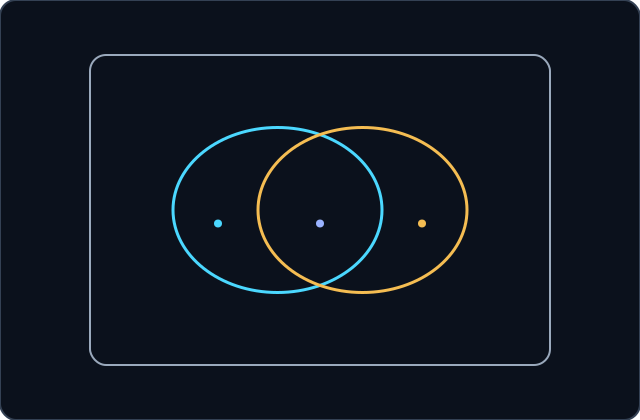
Three places and three answers: is in alone, in alone, and in both. The union is all three together; the intersection is ’s place by itself.
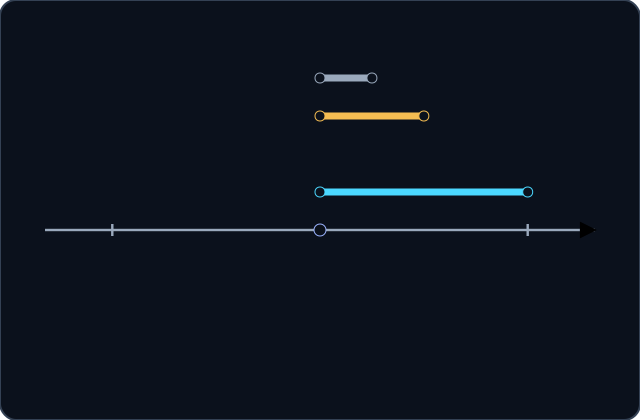
The intervals are nested and none is empty, yet : any is missed by every with , and itself is in none of them. An infinite intersection can lose everything that each finite one kept.
Applications
Practice
Collect elements from either set
The number 5 is shared and stays in the result. The result also contains 1 and 9.
Try it
Let and . What is ?
Keep only shared elements
Only 5 passes both membership checks.
Try it
Let and . What is ?
Try it
An object x belongs to both A and B. The statement is true.
Recognize disjoint sets
The number 4 differs from 7, so no element belongs to both sets.
Try it
Let and . What is ?
Evaluate parentheses first
If , and , then .
The inner union contains 1, 2, and 3. Of these, only 1 also belongs to P.
Try it
Let , and . Find .
Unions Over an Index Set
When there are more than two sets, they are named by an index and the operations run over the whole family.
Try it
Let for . What is ?
Try it
For the same , what is ?
Try it
A family of non-empty sets can have an empty intersection.
Try it
Which identity is correct for a family and a set ?
What You Learned
- is an inclusive or; is an and.
- A family has for "some index" and for "every index".
Final checkpoint
Try it
for every non-empty index set .
Completion
Lesson complete
Great work! You now know how to:
- Compute unions and intersections of listed sets
- Read and use the notation for a family indexed by a set
- Tell "for some index" from "for every index"
- Give a family of non-empty sets with empty intersection