Intuition
Everything after this chapter is a statement about functions, so the word has to be pinned down. A function is not a formula: it is a rule that assigns to each input exactly one output, together with the two sets it runs between. Two rules that agree everywhere are the same function even when their formulas look nothing alike, and one rule can fail to be a function for a reason that has nothing to do with arithmetic — it may leave an input unanswered, or answer it twice.
A departures board assigns to each flight number exactly one gate. It is a function from flight numbers to gates. It would stop being one if a flight appeared twice with different gates, or if a listed flight had no gate at all. Two gates for one flight is the failure that matters; two flights at one gate is perfectly ordinary.
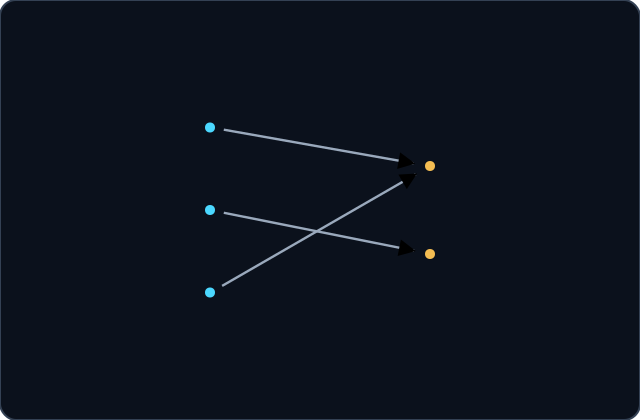
A function sends each of somewhere in . Two of them may land on the same point — that is allowed, and here . What is forbidden is a point of with two arrows out of it, or with none.
From the product to the function
The ordered pair remembers which came first, so although . The Cartesian product is the set of all such pairs with the first from and the second from . A relation from to is any subset of , and a function is a relation with one extra demand: each element of occurs as the first entry of exactly one pair.
What the notation carries
- names three things at once: the rule, the domain , and the codomain . Change the domain and you have changed the function.
- exactly when and . Ordered pairs are compared entry by entry.
The product distributes over a union
Two sets are equal when the same objects belong to both, so take an arbitrary object and follow what its membership in each side means. Every element of either side is an ordered pair, so write it as one and unpack the conditions on its two entries. Each step is a statement that can be read in both directions, which is what makes the chain a proof of equality rather than of one inclusion.
Proof steps
Take an arbitrary element of the left-hand side; it is a pair, because everything in a product is.
Membership in a product is a condition on each entry separately.
Unpack the union in the first entry.
And distributes over or — the same law that distributes intersection over union.
Fold each bracket back into a product, and the pair of them into a union.
The object was arbitrary and every step reads both ways, so the two sets have the same elements.
Applications
Practice
A Pair Remembers Its Order
A set forgets order and repetition. An ordered pair keeps both, and that is the whole difference.
Try it
Comparing with , and with , which statement is true?
Try it
Let and . How many elements does have?
Try it
Which of these relations from to is a function?
Try it
A function may send two different inputs to the same output.
A Function Carries Its Domain
Two rules with the same formula but different domains are different functions. The domain is part of what is named.
Try it
and are both given by the formula . What is true?
Try it
For , , what is the range?
Try it
The rules and , both from to , are the same function.
Try it
How many functions are there from a set with elements to a set with elements?
What You Learned
- is the set of ordered pairs, and a relation is any subset of it.
- A function answers every input exactly once; repeated outputs are allowed.
- names the rule, the domain and the codomain, and all three matter.
- The range is the set of values actually taken, and it may be smaller than the codomain.
Final checkpoint
Try it
The relation is not a function from to . Why not?
Try it
for every set .
Completion
Lesson complete
Great work! You now know how to:
- Read and compare ordered pairs, and count a Cartesian product
- Say exactly when a relation is a function, and name which demand fails when it is not
- Tell the range of a function from its codomain
- Decide when two differently written rules are the same function