Intuition
Think of a set as a collection of distinct objects, called its elements. The objects might be numbers, points, or people. Membership tells us whether a particular object belongs to the set. In this lesson, we will work with small sets of numbers.
Imagine the set of students enrolled in a class. To check membership, ask whether a particular student is enrolled. Being first or last on the attendance list makes no difference to membership.
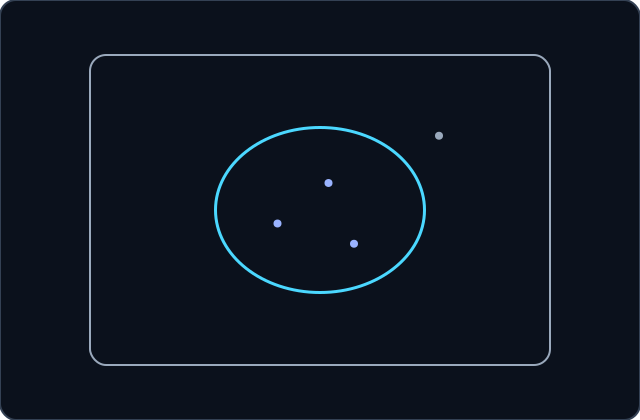
A set holds some things and not others, and that is the whole of what it does. With : , and however close to the ring it is drawn.
Basic notions and notation
We treat set and membership as basic notions in this course; the collection picture is an intuitive description. For a small finite set, we can list all its elements between braces, separated by commas. In the example below, A names the set whose elements are 2, 4, and 6.
Reading the symbols
- means "4 is an element of A." The symbol expresses membership.
- means "5 is not an element of A." The symbol expresses non-membership.
Applications
Practice
Read a membership statement
. Then .
The number 3 appears in M, so the statement says that 3 is an element of M.
Try it
Let . Which symbol completes the true statement ?
Try it
Let . Which statement is true?
Order does not change a set
Both sides contain 1, 3, and 5, with no other elements. The symbol = says that the sets are equal.
Try it
Let . Which set is equal to B?
Count distinct elements
The distinct numbers are 4 and 9. This set has two elements, even though the first notation lists three numbers.
Try it
Let . How many distinct elements does C have?
The empty set has no elements
, but .
The symbol ∅ denotes the empty set. The symbol ≠ means "is not equal to." Zero is an element of the set on the right.
Try it
Let . Which statement is true?
Try it
Use what you have learned. Let . Which statement is true?
Describing a Set by a Property
A set can be given by listing its elements or by naming a condition they satisfy. The second form is the only one available once the set is infinite.
Try it
Which set is ?
Try it
How many elements does have?
Try it
and .
What You Learned
- A set is decided by its elements alone: order and repetition are invisible.
- relates an object to a set; a set may be listed or described by a property.
- has no elements, and has one.
- name the number systems this course works in.
Final checkpoint
Try it
Which statement about the empty set is true?
Completion
Lesson complete
Great work! You now know how to:
- Read and write membership statements
- Describe a set by listing it or by naming a property
- Tell the empty set from a set whose only element is empty
- Name the four number systems