Intuition
A function sends points to points, but it also sends whole sets to whole sets, and it does so in two directions. Pushing a set forward gives its image: everything the function hits from inside that set. Pulling a set back gives its preimage: everything that lands inside it. The two look symmetric and are not, and the difference decides which of them the rest of analysis is built on.
A photograph maps a scene to a print. The image of the garden is the patch of print the garden occupies. The preimage of a red patch is everything in the scene that came out red — which may include a flower and a jumper that were nowhere near each other. Pulling back never has to ask whether anything was hit twice; pushing forward does.
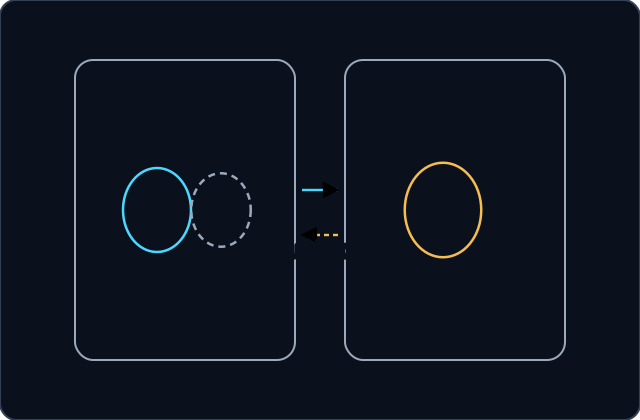
The image is what reaches. The preimage of a set in is everything sent into , and it may be bigger than any one set that was pushed forward — here the dashed also lands inside , so it belongs to the preimage too.
Two operations on sets
Let . For the image is , a subset of . For the preimage is , a subset of . The symbol here is one piece of notation for the preimage and does not claim that can be undone; is defined for every function whatsoever.
What survives each direction
- Preimages respect every operation: , and .
A preimage respects intersection
Take an arbitrary point of the domain and unpack what it means for it to lie in each side. Membership in a preimage is a statement about where the point is sent, so each step replaces a statement about sets by a statement about the single value — and at that level the equality is the definition of intersection. Every step reads in both directions, which is what makes this an equality and not merely an inclusion.
Proof steps
Take an arbitrary point of the domain and suppose it lies in the left-hand side.
Membership in a preimage says exactly where the value lands.
Unpack the intersection, which is the word and.
Fold each half back into a preimage.
Which is membership in the intersection of the two preimages, so the two sets agree.
Applications
Practice
Push Forward, Pull Back
The image collects the values taken; the preimage collects the inputs that land in a given set.
Try it
Let , , and let . What is ?
Try it
For the same , what is ?
Try it
Writing assumes that has an inverse function.
Where the Two Directions Part
Preimages respect every operation. Images respect unions only.
Try it
With , and , what are and ?
Try it
holds for every function .
Try it
Let with and . How many elements does have?
Try it
For which functions does hold for every subset of the codomain?
Try it
holds for every function and every subset of the domain.
What You Learned
- is what reaches; is everything that lands in .
Final checkpoint
Try it
Why are preimages easier to work with than images?
Try it
can fail for some function.
Completion
Lesson complete
Great work! You now know how to:
- Compute the image of a set and the preimage of a set
- Use without assuming that can be undone
- Name which set operations each direction respects, and give the counterexample for the one that fails
- Say why the definition of continuity is written with preimages