Intuition
Most differential equations have no formula for their solutions. Even one as short as y′ = x − y² has none in the functions of calculus. Yet the existence and uniqueness theorem says its initial value problem has exactly one solution, so there is something definite to find. A numerical method does not look for a formula. It computes approximate values of that one solution at a chain of points a small step apart, starting from the initial value and using nothing but the slope the equation gives.
A navigator with no satellite fix. From a known position, the speed and the heading give the position an hour later, and from that the position an hour after. Each estimate is built on the last, and a small error in one hour’s reckoning is carried into every hour after it.
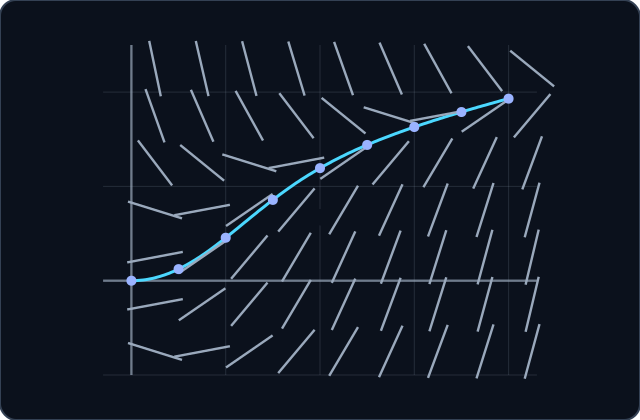
The field of and its solution from , which no formula in elementary functions expresses. A numerical method computes the dots — approximate values at — and nothing in between.
A grid of points, and values on it
For the initial value problem , , choose a step size and the grid points . A numerical method computes numbers with , each from those before it; a one-step method computes from alone. The error at the -th point is , and reaching takes steps.
What a method is, and is not
- The answer is a table of numbers, not a function: values at the grid points and nothing in between.
- It needs a solution to exist and to be the only one. Where the existence and uniqueness theorem does not apply, a method still produces numbers, and they may describe no solution, or only one of several.
- Each step starts from the previous estimate, not from the true solution, so errors are carried forward and add up.
- A smaller step means more points and, for a good method, a smaller error — and more work: halving doubles the number of steps.
- Every one-step method rests on the integral form of the equation proved below: a step is an integral of the slope, and methods differ in how they approximate it.
A step is an integral of the slope
Let y be the solution on an interval holding the step. Because its derivative is f(x, y(x)) at every point there, integrating the equation over the step gives on the left the change in y, by the fundamental theorem of calculus, and on the right the integral of the slope along the solution. The integrand involves the unknown solution itself, so the integral cannot be computed exactly: every one-step method is a rule for approximating it from values the method already has.
Proof steps
The solution satisfies the equation at every point of the step.
Integrate both sides over the step.
The fundamental theorem of calculus, since is continuous.
The value at the end of the step is the value at its start plus the integral of the slope.
So it cannot be evaluated without the solution itself: a method approximates it.
Applications
Practice
Numbers at Grid Points
A numerical method replaces the unknown function by approximate values at the points x₀, x₀ + h, x₀ + 2h, …, computed one after another from the initial value.
Try it
What does a numerical method produce for an initial value problem?
Try it
How many steps of size take a method from to ?
Try it
With and , what is the grid point ?
Try it
A numerical method is of use only for equations that have no formula solution.
A Step Is an Integral
Integrating the equation over one step gives the value at its end from the value at its start and the slope in between.
Try it
By the integral form of the equation, equals which quantity?
Try it
Each step of a one-step method starts from the true value of the solution at its grid point.
Try it
A method run on from returns at every grid point. What do the numbers show?
Try it
A numerical method also gives the value of the solution halfway between two grid points.
Final checkpoint
Try it
, has the solution . Up to what value of can a table of computed values describe it?
Try it
Halving the step size doubles the number of steps needed to cross the same interval.
Try it
Before trusting computed values for , , what should be checked?
Completion
Lesson complete
Great work! You now know how to:
- say what a numerical method computes and what it does not
- set up a grid and count its steps
- prove that a step is an integral of the slope
- check that there is one solution to compute