Intuition
A formula and a table of numbers answer different questions. A formula holds every solution at once, shows how the answer depends on the constants and the parameters, and says what happens as x grows without limit. Numbers answer one initial value problem, for one set of parameters, over one finite stretch — but they answer it for almost any equation. The two check each other: a formula is tested against numbers, and a program against equations whose solutions are known. And some questions only analysis can answer, because numbers never warn that a solution has stopped existing, or that it is not the only one.
A map and a GPS track. The map shows every road and where each one leads; the track records one journey exactly, even across open country with no road at all. Each checks the other, and neither replaces the other.
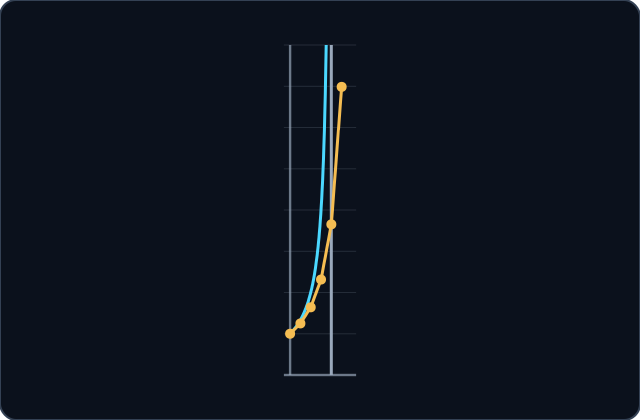
, has the solution , which becomes infinite at and does not exist beyond it. Euler’s method with never notices: its values at and at are the ordinary numbers and .
What each kind of answer can tell you
An analytic solution is a formula: through its constants it gives every solution, it shows how the answer depends on the parameters, and it describes the behaviour for all , including as . A numerical solution is a table for one initial value and one set of parameters on a bounded interval, with an error that can be estimated but not removed. Analysis says whether there is exactly one solution to compute and for how long it exists; numbers then compute it where no formula can. A program is tested by its observed order: the errors on an equation with a known solution should fall by each time is halved.
Using them together
- Test a program on an equation whose solution is known: if its errors fall by a factor each time is halved, the method is working at its order .
- Check the existence and uniqueness conditions before computing: a method runs straight past a blow-up and follows one of many solutions without a warning.
- A formula can be wrong too — a slip in the algebra — and a quick numerical run exposes it.
- The whole family of solutions, the dependence on a parameter and the behaviour for all time belong to the formula; one accurate curve for an equation with no formula belongs to the numbers.
A method can follow one of many solutions without a warning
The right-hand side vanishes at y = 0. So the first Euler step from 0 adds h times 0, and by induction every value is 0, whatever the step. The zero function is a solution, but so is x³, and so is every function that waits at zero and then leaves along a cubic. The method reports one solution with complete confidence; only the failure of the uniqueness condition, which analysis checks, reveals the others.
Proof steps
The initial value.
If a value is zero, the slope there is zero and so is the next value.
By induction, whatever the step .
Yet solves the same problem through the same point, and the method never finds it.
Applications
Practice
Checking the Order
Run the method with h and with h/2 on an equation whose solution is known. The ratio of the two errors is about 2 to the power of the order.
Try it
A program’s errors on a test equation are with step and with . At what order is its method working?
Try it
A program meant to be the Runge–Kutta method shows errors that halve when is halved. What does that suggest?
Try it
A numerical method run on , stops with an error message at , where the solution becomes infinite.
Try it
Which task suits a numerical method better than a formula?
Try it
Euler’s method with on , : what is ?
Try it
Someone claims that solves , . What does a quick Euler run with a short step show at ?
Try it
Every differential equation met in practice can be solved by a formula, given enough effort.
Try it
Euler’s method with on , gives . What is its error at ? Give three decimal places.
Final checkpoint
Try it
A numerical solution shows how the answer depends on the initial value without any further computation.
Try it
A method’s errors at are , and with , and . What is its order?
Try it
Before , is computed numerically, which fact matters most?
Completion
Lesson complete
Great work! You now know how to:
- say what a formula shows that numbers do not, and the reverse
- measure a method’s order from its errors
- prove that a method can follow one of many solutions without a warning
- use each kind of answer to check the other