Intuition
Each Euler step follows a tangent, and the solution bends away from its tangent. Over one step the gap grows with the square of the step: halve the step and the gap is a quarter. But crossing an interval takes more steps when they are shorter — twice as many at half the size — so the gaps add up to something proportional to the step itself. Halve h and the final error halves. That is what it means for Euler’s method to be of order one, and it is why it is slow: ten times the accuracy costs ten times the work.
Rounding every line of a long bill. Each rounding is small, but a longer bill has more of them, and the error in the total depends on both the size of each rounding and how many there are.

One Euler step of length on , started on the solution at . The step follows the tangent there and ends at , while the solution has bent away to . The gap is the local error, for some in the step.
The error of one step, and of all of them
The local error of a step is what it would get wrong if it started on the solution: . Taylor’s theorem gives for some in the step, so . The global error is what the method gets wrong at after all its steps, each started from an estimate. A method is of order when its global error on a fixed interval is at most a constant times . Euler’s method is of order one. The order of a method has nothing to do with the order of the equation.
What the orders say
- A local error of size , over about steps, makes a global error of size : one power of is lost to the number of steps.
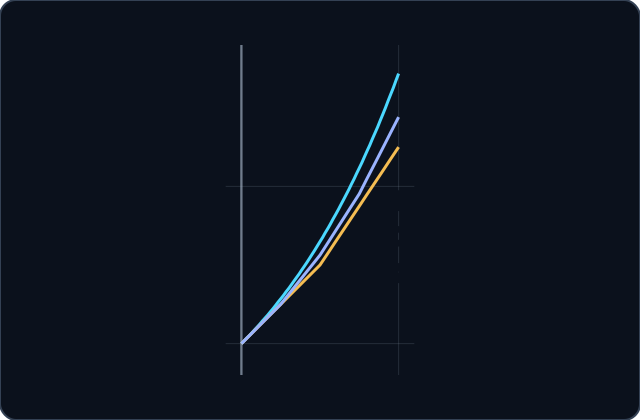
Euler’s method on to with two step sizes. Halving the step takes the error at from to , and further halvings take it to and then : each halving comes nearer to halving the error, the mark of a method of order one.
Euler’s method converges, with an error of order h
Compare one step of the method with the same step of the solution. The solution’s step is an Euler step from the true value plus a local error of at most M h²/2. The slopes at the true value and at the estimate differ by at most K times the difference of the values, by the mean value theorem, so in one step the error is multiplied by at most 1 + hK and gains at most M h²/2. Unwinding this from e₀ = 0 gives a geometric sum, and 1 + hK ≤ e^{hK} bounds it by the formula. On a fixed interval the bound is a constant times h: the method converges, with order one.
Proof steps
Taylor’s theorem: the solution’s own step is an Euler step plus a local error.
Subtract the method’s step .
By the mean value theorem in , the bracket is at most .
Unwind from and sum the geometric series.
Since and . The bound is a constant times .
Applications
Practice
The Gap After One Step
Start a step on the solution itself. The step follows the tangent and the solution bends away from it; the gap at the end of the step is the local error.
Try it
One Euler step with on from the exact value gives . What is the local error ? Give four decimal places.
Try it
The local error of an Euler step is . If is halved, the local error of each step becomes about what?
Try it
If the step size of Euler’s method is halved, the error at a fixed point x becomes about what?
Try it
Euler’s method with has an error of at . About what step makes the error ?
Try it
A method of order one is a method designed for first-order equations.
Try it
For , , Euler’s method with gives at . What is the error ?
Try it
For , , take four Euler steps with . What is the error ?
Try it
Euler’s method makes no error at all on an equation whose solution is a parabola.
Final checkpoint
Try it
For a fixed step size, the bound on the error of Euler’s method can grow exponentially with the length of the interval.
Try it
What is the local error of a step?
Try it
A method gives errors with and with at the same point. To one decimal place, what is the ratio of the first error to the second?
Completion
Lesson complete
Great work! You now know how to:
- tell the local error of a step from the global error of a run
- estimate how the error changes when the step is halved
- prove that the error of Euler’s method is at most a constant times the step
- say what the order of a method measures