Intuition
The direction field already says how to walk. Stand at the starting point, read the slope the equation gives there, and follow it in a straight line for one step. At the new point read the slope again, turn, and take the next step. The path is a broken line of straight pieces, each starting off tangent to a solution. This is Euler’s method, the simplest way to run a differential equation forward, and every better method refines it.
Walking in fog with a compass. You cannot see the path, so you take a bearing, walk ten paces on it, take a new bearing and walk again. Shorter stretches keep you nearer the path, at the cost of stopping more often.
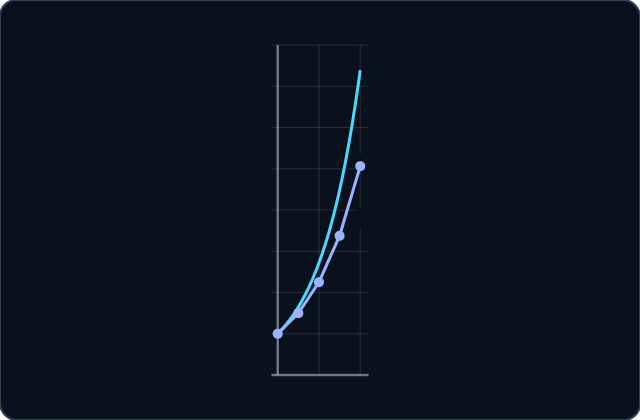
Euler’s method on , , with . Each piece follows the slope at its left end, which is the height there; the solution bends upward away from every piece, and the broken line ends at where the solution has reached .
Follow the slope for one step
Euler’s method for , , with step size : from the point , move along the slope that the equation gives there until . The new height is . In the integral form of the last lesson, it replaces the integral of the slope over the step by the slope at the start times the length of the step.
Doing it by hand
- A table with columns , , and keeps the work straight: each row is computed from the one above.

Euler’s method with on , , over the equation’s direction field. Each piece copies the mark at its left end. The solution dips to a lowest point and then approaches the line ; the broken line does the same, running a little below it.
Euler’s method reaches the exponential
Each Euler step for y′ = y multiplies the current value by 1 + h, so after n steps from 1 the value is (1 + h) to the power n. Reaching a fixed x in n equal steps takes h = x / n, which gives (1 + x/n) to the power n — and that tends to e to the power x as n grows, the limit the analysis course defines the exponential by. So the computed value approaches the exact solution as the step shrinks. The next lesson proves the same for every equation the existence theorem covers, and says how fast.
Proof steps
One Euler step for , where .
By induction on the number of steps, from .
Reach the point in equal steps.
The limit that defines the exponential in the analysis course.
The computed value at x approaches the exact solution as the step shrinks.
Applications
Practice
One Step
From the current point the equation gives a slope. Moving along it for a step of length h changes y by h times that slope.
Try it
Apply one step of Euler’s method with to , . What is ?
Try it
Apply two steps of Euler’s method with to , . What is ?
Try it
Which formula is one step of Euler’s method?
Try it
Euler’s method with on , : what is , the estimate of ? Give four decimal places.
Try it
For , , every Euler estimate with lies below the exact solution at the same grid point.
Try it
In Euler’s method, where is the slope for the step from to evaluated?
Try it
Euler’s method with on , : what is ? Give three decimal places.
Try it
For , , whose solution bends downward, the Euler estimates with lie below the solution.
Final checkpoint
Try it
For , and , the first Euler step gives . What is ?
Try it
Euler’s method gives the exact solution of , , at every grid point.
Try it
Euler’s method with step on gives . With , and ten steps of , what is ? Give three decimal places.
Completion
Lesson complete
Great work! You now know how to:
- take Euler steps by hand from a table
- say where the slope of each step is taken
- prove that the steps reach the exponential as they shrink
- predict whether the estimates run above or below the solution