Intuition
A continuous map cannot tear a space. Send a connected space onto another and the target is connected too, because a split in the target would pull back to a split in the source.
Stretch and fold a sheet of dough however you like without cutting it. Whatever shape results is still one piece, because nothing was ever separated.
Connectedness survives a continuous map
Let be continuous from onto . If is connected then so is . As with compactness, a map that is not onto is covered by applying the theorem to its image with the subspace topology.
The shape of the argument
- The proof is by contradiction: assume the target splits and show the source must split too.
- Continuity turns the two open halves of the split into two open sets of the source.
- Being onto is what makes the two pullbacks non-empty, and that is the only place it is used.
- The theorem runs one way only. A connected image says nothing about the source, since every space maps onto a single point.
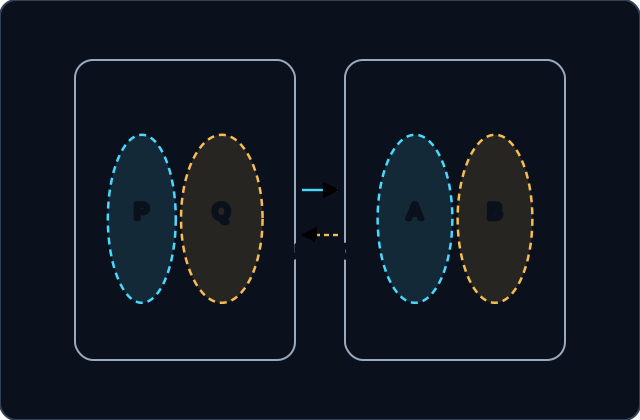
Suppose came apart into two open halves and . Pull both back: continuity makes and open, they share no point because nothing is sent into both, and between them they are all of because every point is sent somewhere. Onto is what keeps each non-empty. So would come apart too — and is connected, so the supposition fails and has no separation.
The continuous image of a connected space is connected
Suppose the target were separated by two open sets. Pull both back through the map. Continuity makes each pullback open. They share no point, because a point sent into one half is not sent into the other. Together they are the whole source, because every point is sent somewhere and everywhere is in one half or the other. And neither is empty, because the map is onto and each half holds a point that something is sent to. So the source would be separated, and it is connected. The assumption fails, and the target has no separation.
Proof steps
Suppose the target had a separation into two non-empty open sets sharing no point.
The map is continuous, so both pullbacks are open in the source.
Every point is sent somewhere and everywhere lies in one half or the other, and no point is sent into both.
The map is onto, so each half holds a value, and whatever was sent there lies in the pullback.
That is a separation of a connected space, which cannot exist. So the target has no separation either.
Applications
Practice
The split is pulled back
The step continuity provides.
Try it
How does the proof use continuity?
Onto makes the pullbacks non-empty
Because some point of is a value of the map.
Try it
Where is the assumption that is onto used?
One direction only
Continuous, onto, connected image, disconnected source.
Try it
If is continuous and onto and is connected, must be connected?
What it buys on the real line
So it is an interval, and it contains everything between any two of its values.
Try it
A continuous quantity along an interval takes the values and . What does this lesson give?
Try it
Can a continuous map send a connected space onto a discrete space of two points?
Try it
Connectedness is a topological invariant.
Try it
A continuous has and . At how many points at least must take the value ?
What You Learned
- A continuous map onto carries connectedness forward.
- A separation of the target pulls back to a separation of the source.
- Onto is what keeps both halves of the pullback non-empty.
- Nothing comes back: a connected image says nothing about the source.
Final checkpoint
Try it
is continuous. What can it be?
Try it
If is continuous and is connected, then is connected.