Math Infinitum
Mapping the lesson.
Loading the workspace…
Topology · Lesson 03
A subset is connected when it is connected as a subspace, and as with compactness the test can be written with open sets of the surrounding space instead of traces. Two facts then do most of the work in this chapter: connected pieces sharing a point unite into a connected whole, and the connected subsets of the line are exactly the intervals.
Read freely. Sign in when you want to save your place.
Sign in to save progressA subset is connected when it is connected as a subspace, and as with compactness the test can be written with open sets of the surrounding space instead of traces. Two facts then do most of the work in this chapter: connected pieces sharing a point unite into a connected whole, and the connected subsets of the line are exactly the intervals.
Two fields joined by a shared gate make one field. Two fields with a road between them do not, however close they lie.
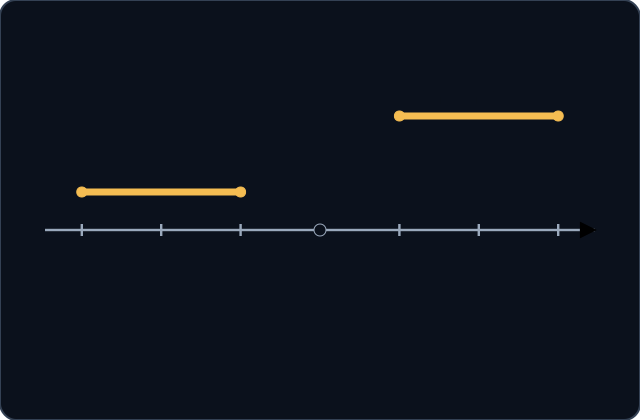
The subset of the line, with the point missing from it. The rays and are open in , each meets , together they cover , and they share no point — a separation of . Any subset of the line that misses a point lying between two of its own comes apart the same way, which is why the connected subsets of the line are the intervals.
A subset is connected when the subspace has no separation. Written with open sets of : there are no open of with , both and non-empty, and . Note that and may meet each other outside ; it is only inside that they must not.
Suppose the union were separated by two open sets. The shared point lies in one of them, say the first. Take any one of the pieces: it lies inside the union, so the same two open sets cover it, and they share no point of it. That makes them a separation of the piece — unless one of the two meets it in nothing. The piece is connected, so one of them must miss it entirely, and since the piece holds the shared point, which is in the first, the one that misses it is the second. This is true of every piece, so the second open set meets no piece at all, and the pieces are everything. So it is empty, and a separation needs both halves non-empty.
Suppose the union came apart, with the shared point in the first open set.
The same two open sets cover each piece and share no point of it.
Each piece is connected, so it cannot be met by both: otherwise the pair would separate it.
Every piece holds the shared point, which lies in the first set, so it is the second that misses each piece.
The second set therefore meets nothing in the union, so it was not a separation after all.
The two open sets come from the whole space; they must cover , meet it both, and share no point of it.
Try it
Which condition says that is disconnected, using open sets of the space around it?
Try it
Which subset of is connected?
Try it
A union of connected sets that all share one point is connected.
Try it
A union of two connected sets is connected.
Try it
contains and but not . What follows?
Try it
How many connected subsets does a space with exactly points and the discrete topology have?
Try it
If is connected then is connected.
Try it
and are connected and . What follows?
Try it
Every connected subset of with more than one point is an interval.
Great work! You now know how to: