Math Infinitum
Mapping the lesson.
Loading the workspace…
Topology · Lesson 06
A space that is not connected still falls into pieces that are, and the pieces can be named: the component of a point is the largest connected subset containing it. Every point lies in exactly one component, so the components cut the space up without overlap, and how many there are is a topological invariant — often the quickest way to show two spaces are not homeomorphic.
Read freely. Sign in when you want to save your place.
Sign in to save progressA space that is not connected still falls into pieces that are, and the pieces can be named: the component of a point is the largest connected subset containing it. Every point lies in exactly one component, so the components cut the space up without overlap, and how many there are is a topological invariant — often the quickest way to show two spaces are not homeomorphic.
An archipelago has islands. Each is as large a piece of land as you can walk without leaving it, no island overlaps another, and counting them tells you something about the archipelago that no map projection can change.
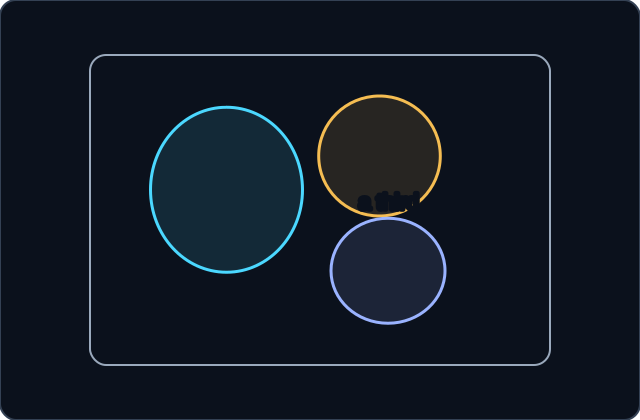
A space in three components. Each is connected, each is as large as a connected subset containing its points can be, and no two overlap — because two connected sets sharing a point would unite into a larger connected set, contradicting the largeness of both. The count is an invariant: a homeomorphism carries components to components.
The component of is the union of every connected subset containing . That union is connected, by the theorem on sets sharing a point, and nothing connected containing is larger — so it is the largest one. Two components either coincide or share no point, and every point lies in its own, so the components partition the space.
Take two components with a point in common. Both are connected, and connected sets sharing a point unite into a connected set, so their union is connected. That union contains the first component and contains the point the first is the component of — and the component of a point is the largest connected set containing it, so the union cannot be larger than the first component. It therefore equals it, which forces the second component inside the first. The same argument with the two swapped puts the first inside the second, so they are equal. Since every point lies in its own component, the components cover the space, and this shows any two of them are equal or share nothing.
Suppose two components share a point.
Both are connected and they share a point, so their union is connected.
The union is a connected set containing the first point, and the component of that point is the largest such set.
The same argument at the second point puts the union inside the second component.
Each is contained in the other, so the two components coincide.
The component of a point is the union of all connected subsets containing it, and that union is itself connected.
Try it
What is the component of a point?
Try it
How many components has ?
Try it
A connected component is always closed.
Try it
A connected component is always open.
Try it
What are the components of ?
Try it
and are not homeomorphic. Which argument shows it?
Try it
How do path components relate to components?
Try it
Two components of a space share a point. What follows?
Try it
A space with exactly one component is connected.
Great work! You now know how to: