Intuition
A hydrogen atom is two particles, not one electron round a fixed nucleus. When two particles interact through a force depending only on their separation, the problem splits: the centre of mass moves freely, as a particle of the total mass, and the separation moves as a single particle of the reduced mass in the potential. Since the proton is 1836 times heavier than the electron, the reduced mass is almost the electron’s, and the correction it makes is small but measured — it distinguishes hydrogen from deuterium in a spectrum.
Two dancers holding hands spin about a point between them, closer to the heavier one, while the pair as a whole drifts across the floor. The drift and the spin are separate motions, and each can be described on its own.
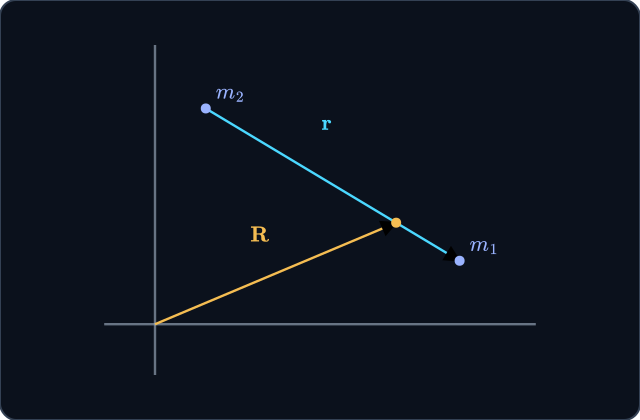
Two particles with . The centre of mass lies on the line between them, three times closer to the heavier one; the relative position is the arrow from one to the other. The Hamiltonian separates into the free motion of and the motion of in the potential.
Centre of mass and relative motion
For , change to the centre of mass and the relative coordinate. The two motions decouple.
Properties
- is the total mass and the reduced mass, always smaller than either mass.
The kinetic energy separates
Express the two momenta through the total momentum and the relative momentum, square, and add with the masses as weights. The cross terms cancel, and what remains is the kinetic energy of the total mass plus that of the reduced mass.
Proof steps
The momenta conjugate to and .
Solve for the particle momenta.
The cross terms cancel.
Simplify the two coefficients.
Applications
Practice
The Reduced Mass
The relative motion of two bodies behaves like one particle with the reduced mass, which is the product of the masses over their sum.
Try it
Two particles have masses 2 and 6. What is their reduced mass?
The Centre Moves Freely
When the force depends only on the separation, the centre of mass moves as a free particle of the total mass, and total momentum is conserved.
Try it
How does the centre of mass of an isolated hydrogen atom move?
Equal Masses
For two equal masses the reduced mass is half of either. Positronium, an electron bound to a positron, has half the reduced mass of hydrogen.
Try it
Hydrogen’s ground state is bound by about 13.6 eV, and the binding is proportional to the reduced mass. About how much is positronium’s ground state bound, in eV?
Total Momentum
The interaction depends only on the separation, so shifting both particles together changes nothing: the total momentum is conserved.
Try it
For two particles interacting through , the total momentum is conserved.
Try it
The proton is 1836 times heavier than the electron. What is hydrogen’s reduced mass in units of ? Give five decimal places.
Try it
Two particles, of masses 3 and 1, sit at and . Where is their centre of mass?
Try it
The reduced mass can be larger than the lighter of the two masses.
Final checkpoint
Try it
A muon is 207 times heavier than an electron. In muonic hydrogen, a muon bound to a proton of 1836 electron masses, what is the reduced mass in units of , to the nearest whole number?
Try it
A two-body system has total momentum and relative energy . What is its total energy?
Try it
Deuterium’s nucleus is about twice as heavy as the proton, 3672 electron masses. What is its reduced mass in units of ? Give five decimal places.
Completion
Lesson complete
Great work! You now know how to:
- separate a two-body problem into centre-of-mass and relative motion
- compute reduced masses and their effect on energies
- explain the isotope shift between hydrogen and deuterium