Intuition
Most forces in nature depend only on distance: gravity, the Coulomb force, the average force a nucleus exerts. A potential is unchanged by every rotation about its centre, so it commutes with every component of angular momentum. Then the energy, and can all be known together, and every stationary state is a function of times a spherical harmonic. The angles are done once and for all; only the radial part is left.
A lighthouse lamp spreads the same beam in every direction around it. Describing its light needs only the distance from the lamp; the direction takes care of itself. A central potential leaves the angles to the spherical harmonics in the same way.
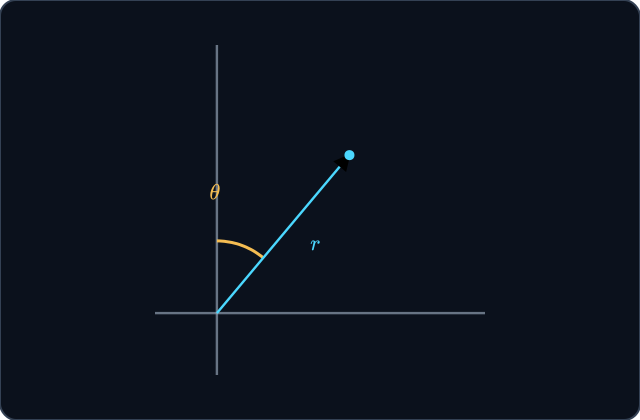
Spherical coordinates, with the axis pointing up: the distance from the centre, the angle from the axis, and the angle round it, not drawn. A central potential depends on alone, so the dependence on and is always a spherical harmonic.
Potentials that depend on distance only
For , the Hamiltonian commutes with and , and the three share their eigenstates.
Properties
- for every component, and : angular momentum is conserved.
A central potential conserves angular momentum
turns momenta and positions round the axis, which leaves and the distance unchanged. So it commutes with both parts of the Hamiltonian; the other components follow by symmetry.
Proof steps
The same pattern as and .
The two terms cancel; commutes with outright.
, and does not depend on .
Both parts of the Hamiltonian commute with .
No axis is special for , so the same holds for every component and for .
Applications
Practice
Three Labels
In a central potential the Hamiltonian, and commute, so each stationary state can be labelled by its energy, its and its .
Try it
Which set of observables can label the stationary states of a central potential?
No Dependence on m
The energy of a central potential cannot depend on : the lowering operator commutes with and moves between the values of without changing the energy.
Try it
How many states share a level with in a central potential, at least?
What Is Conserved
A central potential conserves angular momentum but not momentum: pushing the particle sideways changes its distance from the centre.
Try it
In a central potential, the momentum of the particle is conserved.
Radial Times Angular
Every stationary state of a central potential can be written as a radial function times a spherical harmonic.
Try it
Which function is the angular part of a stationary state with , in any central potential?
Try it
A state in a central potential is . What is its , in units of ?
Try it
commutes with .
Try it
Which potential is central?
Final checkpoint
Try it
A level of a central potential has and no other degeneracy. How many independent states does it hold?
Try it
Why can the energy in a central potential not depend on ?
Try it
In a central potential, is conserved as well as .
Completion
Lesson complete
Great work! You now know how to:
- prove that a central potential conserves angular momentum
- label its stationary states by , and
- explain why energies do not depend on