Intuition
With the angles taken care of, the Schrödinger equation for a central potential becomes an equation for one function of . Written for it looks exactly like the one-dimensional equation on a half-line, with two changes: the potential gains the centrifugal term , and must vanish at the origin. Everything learned about wells and barriers on a line now applies to atoms and nuclei.
A marble rolling in a bowl can be described by its distance from the centre alone, once its angular momentum is fixed: the spinning part of its motion acts like an extra push outwards. The radial equation is that description.
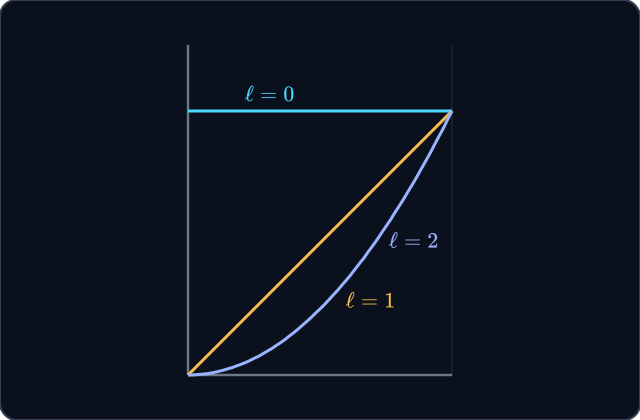
How the radial function starts at the origin for : as a constant, as and as , since . Only the state is nonzero at the centre; the higher , the more the centrifugal term keeps the particle away.
The radial equation
Put into the Schrödinger equation with a central potential. The angles drop out and obeys a one-dimensional equation on .
Properties
- Normalisation: , because and is normalised.
Deriving the radial equation
Split the Laplacian into its radial part and . The spherical harmonic turns into and cancels throughout. The radial part, applied to , is simply , and multiplying by leaves the equation for .
Proof steps
The Laplacian in spherical coordinates.
The angular part acts on the spherical harmonic alone.
Expand both sides: each is .
Cancel from every term.
Multiply by .
Applications
Practice
The Function u
Writing the radial function as turns the radial part of the Laplacian into a plain second derivative, so obeys a one-dimensional equation.
Try it
What condition must meet at the origin?
The Centrifugal Term
The radial equation has the potential plus a centrifugal term .
Try it
In units with , what is the centrifugal term for at ? Give three decimal places.
Only \ell Appears
The radial equation contains through the centrifugal term, but never . So energies depend on and on the radial solution, not on .
Try it
The radial equation depends on the quantum number .
At the Origin
Near the origin the centrifugal term dominates, and grows as to the power .
Try it
Near the origin, for a state grows as . What is ?
Try it
How is normalised?
Try it
Only states with can have a nonzero wavefunction at the origin.
Try it
For and inside a sphere of radius with an impenetrable wall, the lowest is . In units with and , what is its energy? Give three decimal places.
Final checkpoint
Try it
Why does equal ?
Try it
With , by what factor is the centrifugal term for larger than for at the same ?
Try it
For the radial equation is the one-dimensional Schrödinger equation on with an infinite wall at .
Completion
Lesson complete
Great work! You now know how to:
- derive the radial equation for
- use the conditions at the origin and the normalisation of
- read s states as one-dimensional problems on a half-line