Intuition
Everything so far used the Newtonian energy . Near the speed of light the energy of a free particle is : a rest energy , the Newtonian kinetic energy, and corrections that grow with . For the electron in hydrogen, moving at about , where is the fine-structure constant, the first correction is about one part in seventy-five thousand of its kinetic energy — the fine structure. But relativity changes more than numbers. The relation is quadratic in , so every equation built on it has solutions of negative energy as well as positive. And pinning a particle down to within its Compton wavelength gives it momenta of order , energy enough to make a new particle and its antiparticle: a theory of one particle at a time cannot hold at those scales. This chapter follows both threads, to the Dirac equation and its antiparticles, and the next turns them into fields.
A Newtonian map of the Earth drawn on a flat sheet is fine for a town and fails for a continent. Newtonian quantum mechanics is the town map: exact enough for atoms, and wrong at speeds near light.
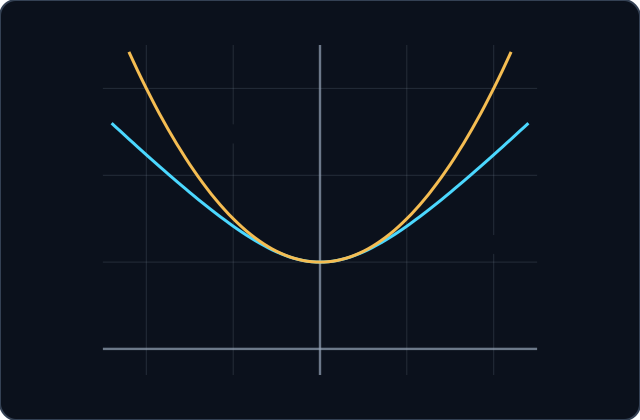
The energy of a free particle against its momentum, in units where : , and the Newtonian , dashed, with the rest energy added for comparison. They agree while ; beyond it the relativistic energy grows only in proportion to .
Why relativity changes quantum mechanics
A free particle of mass and momentum has the energy
Properties
- The first correction to the kinetic energy is , a fraction of about of it: in hydrogen.
The relativistic energy and its first correction
Factor the rest energy out of the square root and expand it by the binomial series in the small quantity . The first term is the rest energy, the second the Newtonian kinetic energy, and the third the first relativistic correction, whose size relative to the kinetic energy is a quarter of .
Proof steps
The energy–momentum relation of special relativity (stated).
Take out .
The binomial series.
Multiply back by .
For hydrogen, gives .
Applications
Practice
The Compton Wavelength
Squeeze a particle into a region of size and its momentum spread reaches : enough energy to make pairs of particles.
Try it
With MeV fm and MeV, what is the electron’s Compton wavelength , in fm? Give the nearest whole number.
Negative Energies
The relation is quadratic in , so a wave equation built on it has solutions of negative energy as well.
Try it
Why do relativistic wave equations have solutions of negative energy?
Small in Atoms
The electron in hydrogen moves at about , so relativity changes its energies by about , a part in twenty thousand.
Try it
In hydrogen, relativistic corrections change the energy levels by several per cent.
Kinetic Energy
The kinetic energy is . At the relativistic energy is , so the kinetic energy is .
Try it
A particle has . What is its kinetic energy , in units of ? Give three decimal places.
Try it
Why can a theory of one particle at a time not hold on scales below the Compton wavelength?
Try it
The Schrödinger equation treats space and time alike.
Try it
For the electron in hydrogen, with . What is , the relative size of the first correction, in units of ? Give two decimal places.
Final checkpoint
Try it
Where do relativistic effects in atoms become large?
Try it
The first correction to the Newtonian kinetic energy is .
Try it
At large momentum, , how does the energy grow?
Completion
Lesson complete
Great work! You now know how to:
- expand the relativistic energy and find its first correction
- explain where negative energies come from
- say why one particle at a time fails below the Compton wavelength