Intuition
The quickest relativistic equation turns into operators: , the Klein–Gordon equation. Schrödinger found it first, tried it on hydrogen, got the fine structure wrong and put it aside; the trouble was the electron’s spin, which it has no room for. Its plane waves come with both signs of energy, , separated by a gap of . Worse, because the equation is second order in time, the density that it conserves is not but a combination of and its time derivative, and it can be negative. So cannot be the wavefunction of one particle. The equation came back as the equation of a field for particles of spin zero, like the pion, whose conserved density is a charge: positive for particles, negative for antiparticles.
A balance sheet can show a negative number where a count of objects cannot. The Klein–Gordon density behaves like a balance of charge, particles minus antiparticles, not like a count of one particle’s presence.
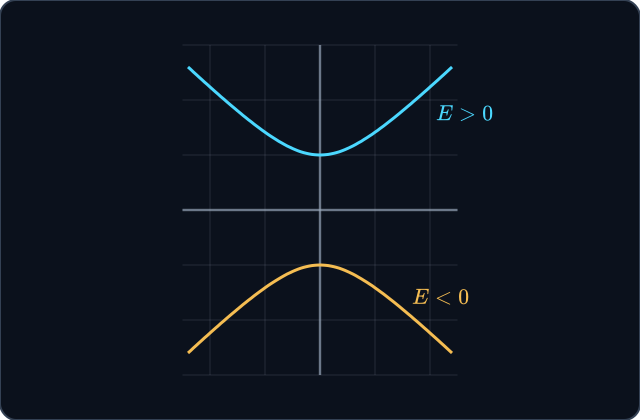
The energies of Klein–Gordon plane waves against momentum, in units where : two branches, , separated at by the gap . The lower branch is what a single-particle reading cannot explain.
The Klein–Gordon equation
Replacing and in gives
Properties
- It is Lorentz invariant: .
The conserved Klein–Gordon density
Multiply the equation by and its conjugate by , and subtract: the mass terms cancel, and what is left is a time derivative plus a divergence. For a plane wave the density is proportional to , so it is negative on the lower branch: it cannot be a probability.
Proof steps
The mass terms cancel.
Each bracket is a product-rule derivative.
Multiply by ; is the current of the Schrödinger equation.
: the density has the sign of .
Applications
Practice
Two Branches
Klein–Gordon plane waves have : for every momentum a positive and a negative energy.
Try it
A Klein–Gordon plane wave has MeV and MeV. What is its negative-energy value, in MeV?
The Equation
Put and into , acting on .
Try it
How is the Klein–Gordon equation obtained?
Not a Probability
The density the Klein–Gordon equation conserves involves and has the sign of the energy, so it can be negative.
Try it
The conserved Klein–Gordon density is always positive, so it can be a probability density.
Second Order in Time
Being second order in time, the equation needs and at the start, and its conserved density contains both.
Try it
Why does the Klein–Gordon density involve and not only ?
Try it
What is the gap between the two branches of energies at for a particle with MeV, in MeV? Give three decimal places.
Try it
The Klein–Gordon equation describes particles of spin zero.
Try it
A negative-energy plane wave has and . What is its density ?
Final checkpoint
Try it
Why did the Klein–Gordon equation fail for the fine structure of hydrogen?
Try it
Read as a field equation, the Klein–Gordon density is a charge density, positive for particles and negative for antiparticles.
Try it
Why is the Klein–Gordon equation Lorentz invariant?
Completion
Lesson complete
Great work! You now know how to:
- derive the Klein–Gordon equation from the energy–momentum relation
- show that its conserved density can be negative
- say what the equation describes