Intuition
The three corrections from the Dirac equation shift hydrogen’s levels at order , a few hundred-thousandths of the binding energy, and they can be computed with first-order perturbation theory in the hydrogen states. The kinetic correction depends on ; the spin–orbit coupling depends on and and acts only for ; the Darwin term, a smearing of the electron over its Compton wavelength, acts only on s states, which reach the nucleus. Each depends on , yet their sum does not: the result depends only on and , . So and stay degenerate, and lies above them by eV, a line split by 11 GHz. The Dirac equation, solved exactly, gives the same formula to this order. The one thing it misses, the small Lamb shift pushing above , belongs to the quantised electromagnetic field.
Three accountants each round a bill differently, and the rounding errors cancel so neatly that the total depends only on the sum paid, not on the items. The three corrections depend on , and their sum does not.
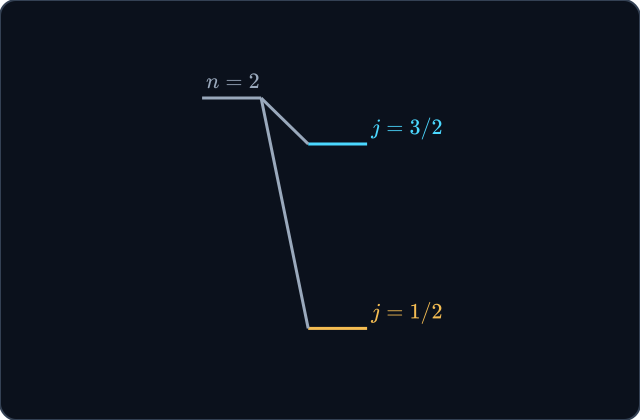
Hydrogen’s level without and with fine structure, to scale in units of : moves down by and with by , leaving them apart. The Lamb shift, from the quantised field, would lift a tenth of the way back up.
Fine structure
To first order in the three corrections, hydrogen’s levels depend on and only:
Properties
- The kinetic, spin–orbit and Darwin corrections each depend on ; their sum does not: levels of equal and stay degenerate, such as and .
The fine-structure formula
Average each correction over a hydrogen state. The kinetic term is rewritten with , which needs and . The spin–orbit term needs and the value of in a state of given . The Darwin term needs the density at the nucleus. Adding them for , and for , the -dependence cancels.
Proof steps
in the state; and as stated.
For , with and .
for the Coulomb potential; only s states reach .
For both signs the in the kinetic term trades for ; for the Darwin term plays the part of the spin–orbit one.
Applications
Practice
The Formula
To order , hydrogen’s levels depend only on and .
Try it
What is the fine-structure shift of hydrogen’s ground state, , , in units of ? Give three decimal places.
Degenerate in l
The three corrections each depend on , but their sum depends only on and : and keep the same energy.
Try it
Which level of hydrogen stays degenerate with under the fine structure?
The Darwin Term
The Darwin term involves the Laplacian of the Coulomb potential, a delta function at the nucleus, so only s states feel it.
Try it
The Darwin term shifts only s states.
What Cancels
Adding the kinetic and spin–orbit shifts for , the in each trades for ; the Darwin term does the same job for .
Try it
Why does the fine structure depend only on and ?
Try it
The – splitting is , with eV. With eV s, what frequency is it, in GHz? Give two decimal places.
Try it
The Dirac equation predicts the Lamb shift between and .
Try it
How many distinct fine-structure levels does hydrogen’s shell have?
Final checkpoint
Try it
How large is the fine structure compared with the binding energy of hydrogen?
Try it
Solving the Dirac equation exactly for hydrogen gives the same fine structure to order .
Try it
Why can the fine structure be found with first-order perturbation theory in the states ?
Completion
Lesson complete
Great work! You now know how to:
- average the three relativistic corrections over hydrogen states
- combine them into the fine-structure formula
- say what the formula leaves to the quantised field