Math Infinitum
Mapping the lesson.
Loading the workspace…
Linear Algebra · Lesson 04
A linear equation constrains several unknowns without ever multiplying two of them together. Several such equations, read at once, ask for the lists of numbers that satisfy all of them.
Read freely. Sign in when you want to save your place.
Sign in to save progressComplete Linear combinations and span first.
A linear equation constrains several unknowns without ever multiplying two of them together. Several such equations, read at once, ask for the lists of numbers that satisfy all of them.
An order may have to meet a weight limit and a budget at the same time. Meeting one of the two and breaking the other is not an acceptable order.
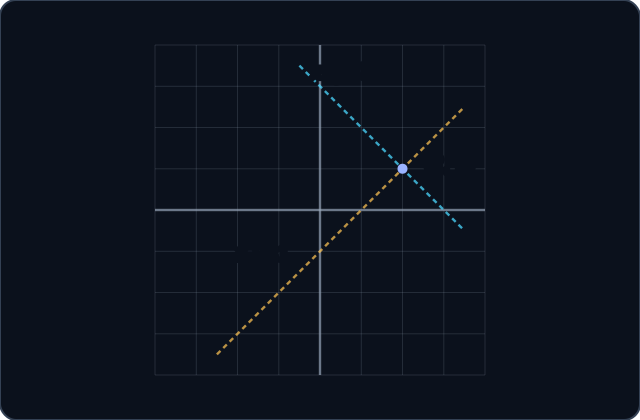
Each equation is a line, and every point on it satisfies that one equation. A solution has to satisfy both at once, so it is where the lines cross — here the single point .
In a linear equation every unknown stands alone, multiplied by a number. Products of two unknowns, powers and roots of them are all excluded. A system is a finite collection of linear equations in the same unknowns, and a solution is one list of numbers that satisfies every equation of the system at once.
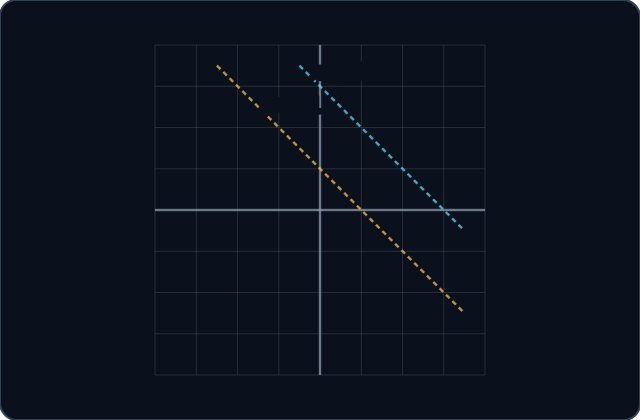
The same left-hand side with two different right-hand sides gives parallel lines, which never meet. No list of numbers satisfies both, and that is what inconsistent means.
The two sides say one thing in two vocabularies. A solution is a list of numbers that weights the coefficient vectors so that they add up to , and that is precisely what membership of their span asks for. Each side therefore hands over exactly what the other needs.
Write the system as one vector equation, which reading the coefficients down the columns allows.
A solution is a list satisfying every equation, so after the rewriting it is a list satisfying that one vector equation.
This is what means: some scalars build the vector.
The two definitions ask for the same numbers. A solution supplies the scalars, and scalars that work form a solution.
Each side produces the other, so the statement holds in both directions.
is linear; is not
In the second, the two unknowns multiply each other rather than being weighted by numbers.
Try it
Which of these is a linear equation?
solves but not
The second equation gives , so the pair fails the system as a whole.
Try it
Which pair solves the system and ?
Some pair of weights turns the two coefficient vectors into ; that pair is a solution.
Try it
A system has coefficient vectors and right-hand side . What does it mean for the system to be consistent?
Four equations in two unknowns, and yet exactly one solution, because three of them say the same thing.
Try it
A system has 4 equations in 2 unknowns. What follows?
Try it
Write the system , as a single vector equation. Which is correct?