Math Infinitum
Mapping the lesson.
Loading the workspace…
Linear Algebra · Lesson 03
Scale a few fixed vectors, add the results, and you reach a new vector. Everything reachable that way from one fixed list is called its span, and it is usually far larger than the list.
Read freely. Sign in when you want to save your place.
Sign in to save progressComplete Adding and scaling first.
Scale a few fixed vectors, add the results, and you reach a new vector. Everything reachable that way from one fixed list is called its span, and it is usually far larger than the list.
With coins of two values you can pay a whole range of amounts. Which amounts you can reach depends on the two values, not on how many coins you happen to hold.
A linear combination weights each vector of a fixed list by a scalar and adds the results. The scalars may be any real numbers at all, negative and zero included. The span of the list is the set of every vector that some choice of scalars produces.
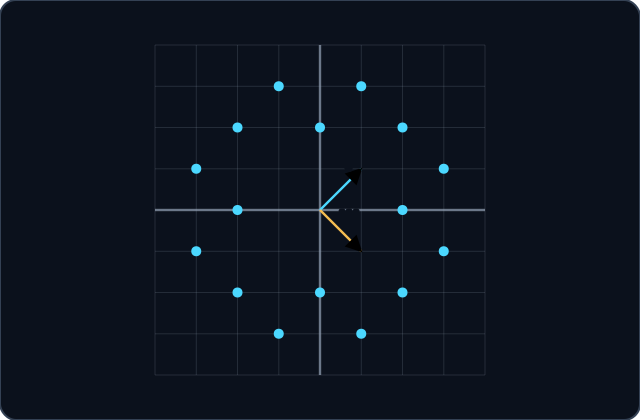
Each dot is for some pair of whole numbers, and they are only a sample: the scalars may be any real numbers at all. Given that freedom this pair reaches every point of the plane, which is why a span is usually far larger than the list that makes it.
Membership of the span means that some scalars build the vector, so name the scalars that build each of and . Adding the two expressions and gathering the terms belonging to each leaves an expression of exactly the same shape, with the sums of the scalars as its weights.
Being in the span means some scalars build the vector. Name the ones that build .
Do the same for , with its own scalars, over the very same list of vectors.
This is with the terms belonging to each gathered together, which addition of vectors permits.
Each bracket collapses to a single term by the rule for scaling by a sum.
The result is a linear combination of the same list, so it lies in the span.
The same scalar 3 works in both positions, so is a combination of .
Try it
Is a linear combination of ?
A negative fraction and a positive whole number are both legitimate weights.
Try it
Which scalars may appear in a linear combination?
Every reachable vector has its two components equal, which is a line and not a plane.
Try it
What is the span of the single vector in ?
Whatever a and b are, the result is a multiple of .
Try it
What is the span of and in ?
Try it
Let and . Which vector is not a linear combination of and ?