Math Infinitum
Mapping the lesson.
Loading the workspace…
Linear Algebra · Lesson 02
Two vectors of the same length are added one position at a time, and a vector is scaled by multiplying every component by a single number. Both results stay in the same space.
Read freely. Sign in when you want to save your place.
Sign in to save progressComplete Vectors and coordinates first.
Two vectors of the same length are added one position at a time, and a vector is scaled by multiplying every component by a single number. Both results stay in the same space.
Two shopping lists with the same items add up column by column. Cooking for twice as many guests multiplies every quantity by the same two.
Addition is defined only between vectors with the same number of components, and it acts separately in each position. A scalar is an ordinary real number; multiplying a vector by it stretches every component by the same factor. Both operations produce a vector in the same they started in.
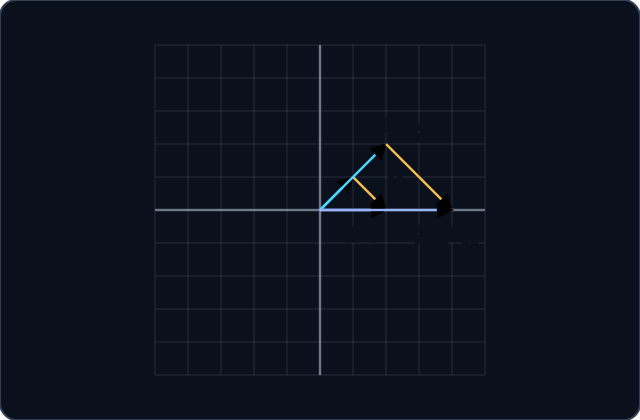
The large triangle is the small one at twice the size. Doubling and and then adding reaches the same place as adding first and doubling after, which is what says.
Both sides are vectors with the same number of components, so by the definition of equality they are equal exactly when they agree in every position. In position i the left side is and the right side is , and those two real numbers are equal by the distributive law for real numbers.
Fix two vectors with the same number of components and one scalar.
Read position i of the left-hand side, using first the definition of addition and then the definition of scaling.
These are three real numbers, so the distributive law for real numbers applies to them.
The same number is position i of the right-hand side, by the two definitions read in the other order.
Both sides have n components and agree in every position, which is what equality of vectors demands.
Position 1 gives , position 2 gives .
Try it
Let and . What is ?
The middle component is , which is the scaling rule applied to zero like any other number.
Try it
What is ?
Position 3 exists on one side only, so this expression names nothing.
Try it
Let and . What is ?
A number goes in on the left and a vector comes out on the right.
Try it
Which statement holds for every ?
Try it
Which identity holds for all vectors of the same length and all scalars ?