Intuition
Some subsets of a space are worlds of their own: adding two of their vectors, or scaling one, never takes you outside. Those are the subsets worth a name.
The whole numbers are closed under addition, since adding two of them never produces anything else. Halving one does leave them, so they are not closed under everything.
Subspaces
A subset of a vector space is a subspace when it contains the zero vector and stays inside itself under both operations. All three conditions are asked for, and the first rules out the empty set. A subspace is a vector space in its own right: the eight rules hold for its vectors because they hold for all of . In a line through the origin is a subspace; the same line shifted away from the origin is not.
Testing a subset
- The span of vectors of , the set of all their combinations, is written , as in .
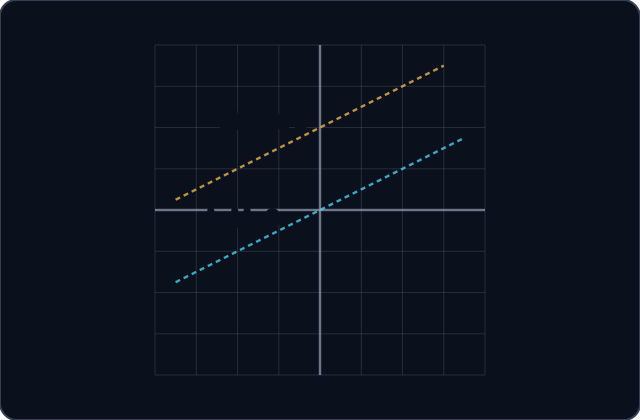
Both are lines. The blue one passes through the origin, and adding or scaling its vectors never leaves it, so it is a subspace. The amber one misses the origin: scaling one of its vectors by zero leaves it immediately, and the first condition already fails.
A span is a subspace
All three conditions are read straight off the shape of a linear combination. Every weight zero gives the zero vector; adding two combinations of the same list gives another, because the weights on each vector add; and scaling one multiplies every weight, which leaves a combination of the same list.
Proof steps
Taking every weight to be zero shows that belongs to the span; each is , by the theorem of the lesson on vector spaces.
Add and and collect the terms on each : the weights add, and the result is again a combination of the same list.
Scaling a combination multiplies each weight, which is again a combination of the same list.
All three conditions hold, which is the whole of the definition.
Applications
Practice
The origin has to be there
A line, but does not satisfy , so it is not a subspace.
Try it
Is the line in a subspace?
Closed means staying inside
The conclusion names , not the space around it.
Try it
Which set is a subspace of ?
Spans are subspaces automatically
Still a combination of the same two vectors, so still in the span.
Try it
Is the span of and a subspace of ?
The two extremes
True of every subspace .
Try it
Which is the smallest subspace of ?
Try it
Which subset of is not a subspace?
Subspaces Anywhere
The three conditions make sense in any vector space: contain , stay inside under addition, stay inside under scaling. A subspace is then a vector space in its own right, because the rules hold for its vectors as they do for all the others.
This is a subspace of : the zero polynomial is in it, and sums and multiples of polynomials with value at still have value there. Those with are not: the zero polynomial is missing.
Try it
Which subset of is a subspace?
The Null Space
For an matrix , the solutions of form a subspace of , called the null space of and written .
Try it
is a matrix and . Which set is a subspace of ?
Try it
The union of the two coordinate axes of is a subspace.
Try it
The intersection of two subspaces of a vector space is again a subspace of .
Try it
Which subset of is a subspace?
Try it
For which is the set a subspace of ?
What You Learned
- A subset of a vector space is a subspace when it contains and is closed under addition and scaling.
- A span is always a subspace, and so is the null space of a matrix.
- Intersections of subspaces are subspaces; unions usually are not.
- One condition failing is enough to rule a subset out.
Final checkpoint
Try it
Which subset of is a subspace?
Try it
A subset that contains and is closed under scaling must be a subspace.
Try it
For every matrix , the solutions of form a subspace.
Completion
Lesson complete
Great work! You now know how to:
- test a subset of any vector space with the three conditions;
- recognise spans and null spaces as subspaces;
- find the condition that fails when a subset is not a subspace;
- use intersections, and distrust unions.