Intuition
A list of vectors carries repeated information when one of them is already reachable from the others. Independence is the condition that none of them is, so every vector in the list earns its place.
Three witnesses are worth three only if none is repeating what another said. If one merely repeats, the account is really from two.
Independence and dependence
A list is linearly independent when the only weights making the combination zero are all zero. Any other choice of weights giving zero makes the list dependent. Note that this is a condition on the whole list, not on any single vector.
Reading the condition
- All weights zero always gives ; independence says nothing else does.
- A list containing is dependent: weight that vector by 1 and the rest by 0.
- Two vectors are dependent exactly when one is a multiple of the other.
- More than vectors in are always dependent: as the columns of a matrix they give a homogeneous system with more unknowns than equations, which has a non-zero solution.
- In , vectors are independent exactly when the matrix with them as columns has a pivot in every column.
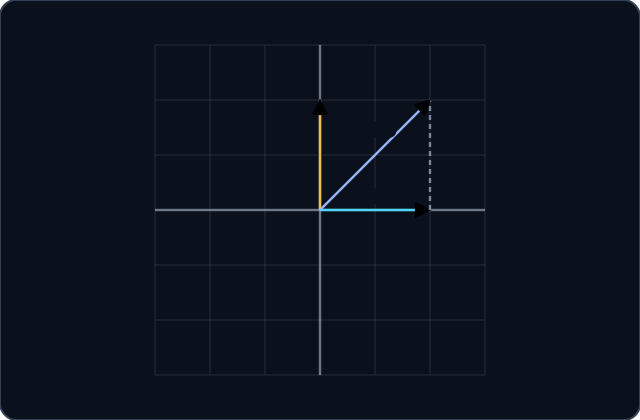
Here , so the weights give without all being zero and the list is dependent. The dashed step is being reached from the other two, which is what dependence always amounts to.
Dependence means one is reachable
If some weight is not zero, divide the relation by it and move that vector alone to one side; what remains expresses it through the others. Running the argument backwards, an expression of one vector through the others becomes a relation with weight minus one on it, which is not zero.
Proof steps
Dependence gives such a relation with at least one weight not zero; fix one and call it .
Move every other term to the far side, which is allowed because each has a negative.
Divide by , which is legitimate exactly because it is not zero.
The other direction: move across to get a relation whose weight on it is .
Each direction has been shown, so the two conditions are the same condition.
Applications
Practice
Only the obvious way to zero
forces
That forcing is exactly what independence claims.
Try it
What does it mean for a list to be linearly independent?
Two vectors is a simple test
So and are dependent.
Try it
Are and independent?
A zero vector spoils any list
A relation with a non-zero weight, found without looking at the other vectors.
Try it
A list contains the zero vector. What follows?
Dependent means one is already reachable
So the list of all three is dependent, and dropping leaves the span unchanged.
Try it
The list , , in is dependent. What does that tell you?
Try it
Which list in is independent?
Test by Row Reduction
Put the vectors in as the columns of a matrix . A combination with weights is , so the vectors are independent exactly when has only the solution : when every column of an echelon form holds a pivot.
Column 3 has no pivot, so , , are dependent. The free variable gives the relation: .
Try it
in are the columns of , and an echelon form of has pivots in columns 1 and 3 only. What follows?
Try it
For which are , and dependent?
Beyond Lists of Numbers
In a combination is zero only when every coefficient is zero. So testing polynomials for independence is a homogeneous system, one equation per power of .
That is zero only if and , so : the two polynomials are independent.
Try it
Which list in is dependent?
Try it
Every part of an independent list, taken on its own, is independent.
Try it
If no one of three vectors is a multiple of another, the three are independent.
Relations Survive Row Reduction
and have the same solutions when is an echelon form of , so every relation among the columns of holds among the columns of too. In the reduced form the relations can be read off.
Here column 2 is column 1, and column 4 is column 1 plus column 3.
Try it
The columns of a matrix have the reduced form . Then . What is ?
What You Learned
- Vectors of are independent exactly when the matrix with them as columns has a pivot in every column.
- Relations among the columns survive row reduction and are read off the reduced form.
- Polynomials are tested coefficient by coefficient, which is again a homogeneous system.
- More than vectors in are always dependent.
Final checkpoint
Try it
What is the largest number of independent vectors that can be chosen from , , and ?
Try it
Three vectors of are the columns of a matrix that is not invertible. What follows?
Try it
If are independent, then so are , and .
Completion
Lesson complete
Great work! You now know how to:
- decide independence from the definition and by row reduction;
- read the relations among columns off the reduced form;
- test polynomials and matrices, not only lists of numbers;
- explain why more than vectors of are dependent.