Intuition
Because a basis describes each vector in exactly one way, the weights can be used as a name for it. Those weights are its coordinates, and they depend on which basis was chosen.
The same place has one address by street and another by grid reference. The place has not moved; the system used to name it has changed.
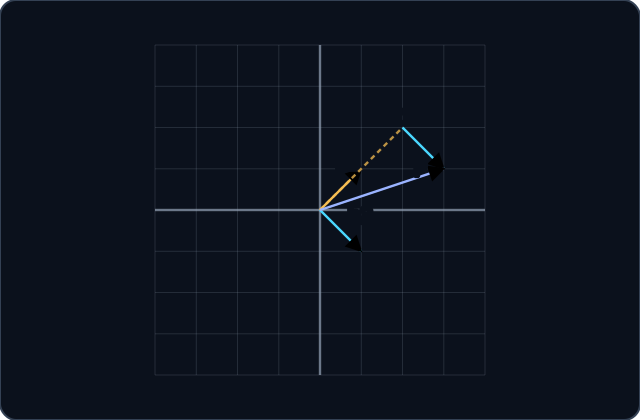
One point, two names. In the standard basis it is ; in the basis drawn here it is , because two of and one of are what reach it. The point has not moved — only the list of arrows the numbers are told to scale.
Coordinates
Fix a basis of a subspace. The coordinates of a vector in that basis are the unique weights that build it, collected into a vector in the order the basis is listed. Reordering the basis reorders the coordinates, and choosing a different basis generally changes them entirely.
What coordinates do and do not change
- In the standard basis of the coordinates of are its own components.
- : a basis vector has a 1 in its own place and zeros elsewhere.
Applications
Practice
The standard basis hides the idea
So the coordinates in the standard basis are 5 and 3, the components themselves.
Try it
What are the coordinates of in the standard basis of ?
Solve for the weights
So in the basis the coordinates are 2 and 1.
Try it
In the basis , , what are the coordinates of ?
A basis vector in its own basis
in a basis of three
The 1 sits in position 2 because is listed second.
Try it
is the basis , of . What are the coordinates of in ?
The vector does not move
Two descriptions, two coordinate lists, one vector.
Try it
A vector is written in two different bases. What changes?
Try it
The basis , is relisted as , . What happens to the coordinates of a vector?
Coordinates by Solving
In , put the basis vectors in as the columns of a matrix . The coordinates are the weights with , found by row reduction.
Try it
In the basis , of , what is the second coordinate of ?
Coordinates of a Polynomial
In the basis the coordinates of are its coefficients : the polynomial becomes a list of numbers. In another basis they are found by comparing coefficients.
Try it
What are the coordinates of in the basis , , of ?
Try it
For every basis and all vectors , .
Try it
In the basis , of , a vector has coordinates . What is its first component?
What You Learned
- lists the unique weights that build from the basis , in order.
- In they solve , with the basis vectors as the columns of .
Final checkpoint
Try it
What are the coordinates of in the basis , ?
Try it
In the basis of , what is the third coordinate of ?
Try it
A non-zero vector can have all its coordinates equal to 0 in some basis.
Completion
Lesson complete
Great work! You now know how to:
- find coordinates by solving a system;
- rebuild a vector from its coordinates;
- find coordinates of polynomials and matrices;
- use that coordinates respect addition and scaling.