Intuition
Glue both pairs of opposite edges of the square and the result is a torus, the surface of a doughnut. It is also the product of two circles, which says something worth keeping: a space built by gluing can turn out to be a space built by multiplying, and the two descriptions are equally good.
Roll the sheet into a tube, then bend the tube round and join its two ends. The order does not matter, and the reason it does not is that both pairs of edges are glued independently of each other.
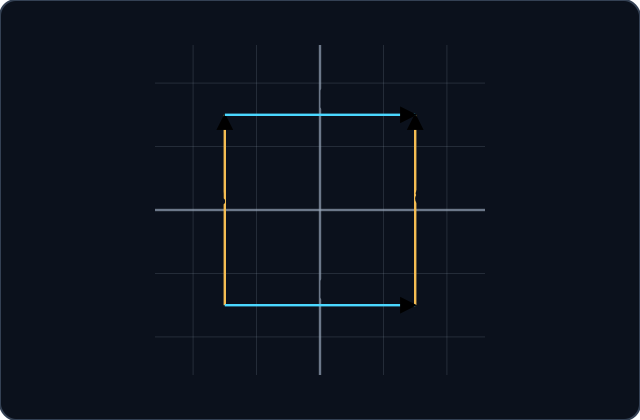
The gluing diagram of a torus: the two edges marked are joined and the two marked are joined, each pair the same way up. The four corners all become a single point, since each is glued to the next round the square.
Both pairs of edges, and a product
Glue to and to in the square. The result is homeomorphic to , the torus. The map wraps each coordinate round its own circle, so the two gluings happen independently — which is exactly what a product is.
What the torus is, and what it is not
- The map with is continuous into the product, onto, and glues exactly the pairs the two instructions name.
The square with both pairs glued is a product of circles
Wrap each coordinate round its own circle. Both coordinates of the result are continuous, so the map into the product is continuous. It is onto, since every pair of angles occurs. Two points of the square have the same image exactly when their first coordinates agree or are the two ends, and the same for their second coordinates — which is precisely what the two gluing instructions say together. The square is compact and the product of two circles is Hausdorff, so the recognition theorem identifies the glued square with the product.
Proof steps
Wrap each coordinate round its own circle.
Each coordinate is continuous, so the map into the product is.
The two coordinates are glued independently, which is the pair of instructions.
A product of compact spaces is compact and a product of Hausdorff spaces is Hausdorff.
The recognition theorem finishes it, as in the two previous lessons.
Applications
Practice
Two Independent Wraps
Gluing both pairs of edges wraps each coordinate on its own, which is a product of circles.
Try it
What is the square with both pairs of opposite edges glued the same way up?
Try it
How many points of the torus do the four corners of the square become?
Try it
Which map proves the torus case?
Try it
Gluing one pair of edges with a flip and the other without gives the torus again.
Try it
The torus is compact and connected.
Try it
What does the product description of the torus buy?
Try it
Why is the torus not homeomorphic to the sphere?
What You Learned
- Both pairs of edges glued the same way up gives the torus.
- It is the product of two circles, and the two descriptions agree.
- All four corners become one point.
- A flip gives the Klein bottle, and the sphere is a different space again.
Final checkpoint
Try it
A square has one pair of edges glued. What is still needed to make a torus?
Try it
A space built by gluing can also be a product of two spaces.
Completion
Lesson complete
Great work! You now know how to:
- glue both pairs of edges and recognise the torus;
- see it as a product of two circles;
- track what happens to the four corners;
- name the Klein bottle and the sphere as different results.