Intuition
Gluing one pair of opposite edges of a square gives a cylinder. The picture is a sheet rolled up, and the proof is the same as for the circle with an extra coordinate carried along untouched. Gluing the same pair with a flip gives a different space, the Möbius band, which is the first sign that how the edges are joined matters as much as which.
Roll a sheet of paper into a tube and tape the two vertical edges. Tape them after turning one of them upside down and you get a band with one side, which no amount of bending turns back into a tube.
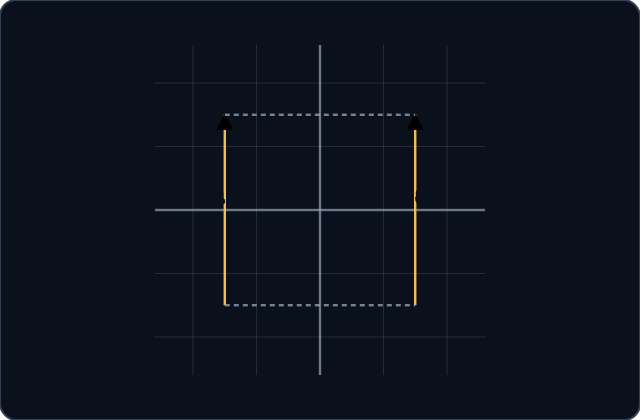
The gluing diagram of a cylinder: the two edges marked are joined, each point to the point at the same height, and the top and bottom edges are left alone. Both arrows point the same way, which is what "same height" means; reversing one of them builds the Möbius band instead.
One pair of edges, joined the same way up
Take the square and glue to for every . The result is homeomorphic to , the cylinder, and the map that proves it wraps the first coordinate round the circle and leaves the second where it is.
What is glued, and what changes if the flip is added
- The map is continuous into the product, because each coordinate is — which is the theorem of the product chapter.
- It is onto, and it identifies with and nothing else, so it glues exactly the instruction.
The square with one pair of edges glued is a cylinder
Send a point of the square to the pair consisting of the angle read off the first coordinate and the second coordinate unchanged. The first part is the wrapping map of the previous lesson and the second is the identity, so each coordinate of the result is continuous, and a map into a product is continuous exactly when its coordinates are. It is onto, since every angle and every height occur. Two points have the same image when their heights agree and their first coordinates wrap to the same angle, which inside the square means they are the two ends of a horizontal line. That is exactly the instruction. The square is compact and the cylinder is Hausdorff, so the recognition theorem finishes it.
Proof steps
Wrap the first coordinate and carry the second through unchanged.
A map into a product is continuous exactly when both coordinates are.
Heights must agree and the two first coordinates must be equal or be the two ends.
A product of compact spaces is compact and a product of Hausdorff spaces is Hausdorff.
The recognition theorem identifies the glued square with the cylinder.
Applications
Practice
Join One Pair, Same Way Up
Gluing to wraps the first coordinate and leaves the second alone.
Try it
Which gluing of the square builds a cylinder?
Try it
Which map proves the cylinder case?
Try it
Gluing to gives a space homeomorphic to the cylinder.
Try it
Why is the map into the cylinder continuous?
Try it
How many boundary circles has a cylinder?
Try it
The cylinder built this way is compact.
Try it
How can one see that the cylinder is not homeomorphic to the square?
What You Learned
- The square with one pair of edges glued the same way up is a cylinder.
- The map wraps one coordinate and carries the other through.
- Continuity comes from the product theorem; the identification from the recognition theorem.
- Flipping one edge builds the Möbius band instead, which is a different space.
Final checkpoint
Try it
Which fact about the target does the recognition theorem need here?
Try it
Reversing one arrow in a gluing diagram can change the space that results.
Completion
Lesson complete
Great work! You now know how to:
- read a gluing diagram of a square;
- build the cylinder and prove it with the recognition theorem;
- use the product theorem for continuity into a product;
- tell the cylinder from the Möbius band.