Math Infinitum
Mapping the lesson.
Loading the workspace…
Topology · Lesson 03
A basis has to fit inside every overlap. Drop that demand and ask only that the family cover the space: take all the finite intersections first, and a basis appears. Such a family is called a subbasis, and it is how a topology is described when only a few conditions matter.
Read freely. Sign in when you want to save your place.
Sign in to save progressNote
Complete Generating a topology from a basis first.
A basis has to fit inside every overlap. Drop that demand and ask only that the family cover the space: take all the finite intersections first, and a basis appears. Such a family is called a subbasis, and it is how a topology is described when only a few conditions matter.
Two rules, "after nine" and "before five", cut the day at one end each. Combining them gives the working day, and the pair of half-days is a cheaper description than the interval it produces.
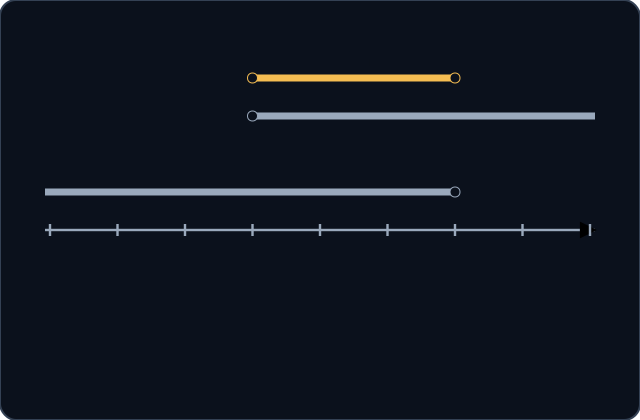
Two rays and what they have in common. and are the members of the subbasis; their intersection is the interval , and intervals are a basis. So the rays alone generate the standard topology of the line.
A subbasis for a topology on is any collection of subsets whose union is . The finite intersections of members of form a basis, and the topology that basis generates is called the topology generated by — the coarsest one in which every member of is open.
The covering condition is inherited: every point lies in some member of the subbasis, which is itself a one-fold intersection and so a member of the collection. For the overlap condition there is nothing to construct: the intersection of two finite intersections of subbasic sets is again a finite intersection of subbasic sets, so it is itself a member of the collection and can serve as the set sitting inside the overlap.
The subbasis covers the space, which gives the first condition.
A single subbasic set is a finite intersection of one term, so it already belongs to the collection.
For the second condition take two members and intersect them.
The result is again a finite intersection of subbasic sets, so it lies in the collection.
The overlap itself can be taken as the set sitting inside it, so both conditions hold.
A subbasis is any family covering the space. Its finite intersections are a basis, and their unions are the open sets.
Try it
What must a family of subsets satisfy to be a subbasis for a topology on ?
Try it
The rays and are taken as a subbasis on . Which topology do they generate?
Try it
Every basis is a subbasis.
Try it
On take . How many distinct non-empty sets arise as intersections of one or more members?
Try it
Why does a subbasis need no overlap condition?
Try it
is a subbasis for the topology on . To prove a map into continuous, what is enough?
Try it
The topology generated by a subbasis is the coarsest topology in which every member of is open.
Try it
On , which topology does the subbasis generate?
Try it
Which family is a subbasis for the standard topology of ?
Try it
A subbasis need not be a basis.
Great work! You now know how to: