Math Infinitum
Mapping the lesson.
Loading the workspace…
Topology · Lesson 02
The last lesson started with a topology and found a family inside it. This one runs the other way: start with a family of subsets and ask whether unions of them form a topology. Two conditions are enough, and meeting them is how most topologies are actually defined.
Read freely. Sign in when you want to save your place.
Sign in to save progressNote
Complete Bases for a topology first.
The last lesson started with a topology and found a family inside it. This one runs the other way: start with a family of subsets and ask whether unions of them form a topology. Two conditions are enough, and meeting them is how most topologies are actually defined.
A builder is handed a pile of bricks and asked whether a wall can be made of them alone. What matters is that the bricks cover the ground and that where two overlap a brick fits in the overlap.
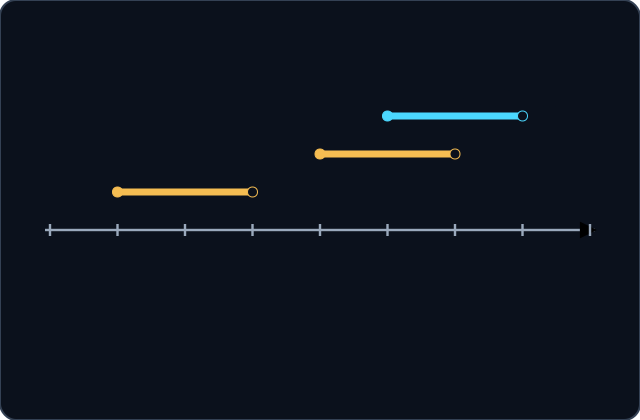
The bricks of the lower-limit topology: half-open intervals , drawn solid at the left end and hollow at the right. They cover the line, and where two of them overlap the overlap is another one — so their unions form a topology, finer than the standard one because is now open.
Let be a collection of subsets of a set — not open sets yet, since there is no topology. Declare open exactly the unions of members of , together with . This collection is a topology precisely when the two conditions below hold, and is then a basis for it.
The empty union is the empty set and the first condition makes the whole space a union, so the forced sets are there. A union of unions of basic sets is again a union of basic sets, so the union axiom holds with nothing to prove. Only the intersection needs the second condition: given a point in the intersection of two generated open sets, it lies in a basic set inside each, and the condition supplies a third basic set inside the overlap. Collecting one such set for each point writes the intersection as a union of basic sets.
The empty union gives the empty set, and the covering condition gives the whole space.
A union of sets each of which is a union of basic sets is again one, so the union axiom is free.
For an intersection, take a point and use that each side is a union of basic sets.
The second condition hands over a basic set inside the overlap.
Collecting one for each point writes the intersection as a union of basic sets, so it is open.
A family of subsets generates a topology exactly when it covers the set and has a member inside every overlap around each point of it.
Try it
Which pair of conditions lets a family of subsets generate a topology by unions?
Try it
Which set is open in the lower-limit topology on but not in the standard one?
Try it
The lower-limit topology on is strictly finer than the standard topology.
Try it
What goes wrong if the second condition fails?
Try it
Do the open squares with generate the standard topology of ?
Try it
The family generates a topology on by unions.
Try it
On , the family is extended by as few subsets as possible so that the two conditions hold. How many sets must be added?
Try it
Which family generates the topology of a metric space?
Try it
On , which family generates a topology by unions?
Try it
A family that generates a topology is automatically a basis for it.
Great work! You now know how to: