Intuition
Turning a state about the axis is another continuous family, and its generator is found the same way: turn by a tiny angle, see what the wavefunction does, and read off the operator. It is , the component of angular momentum. Rotations about different axes do not commute — a book turned about two axes in two orders ends up differently — and that failure is written into the commutators of the three components, which the next chapter builds everything on.
A record on a turntable is rotated a little each moment; knowing how each point moves in one small turn — at right angles to its radius, in proportion to its distance — fixes the whole rotation. Angular momentum is that small turn, written as an operator.
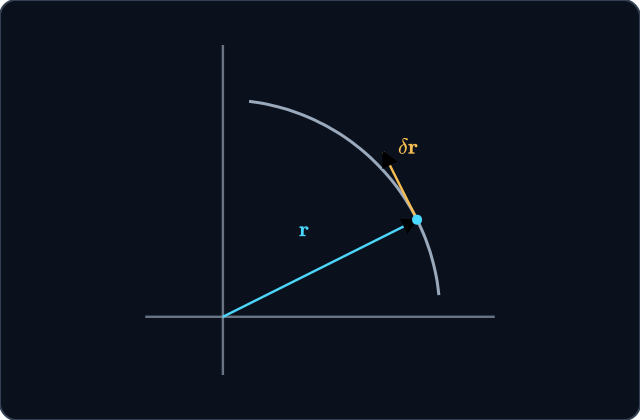
A turn by a small angle about the axis moves the point along its circle, at right angles to : , drawn here with . On wavefunctions that displacement is generated by .
Rotations and angular momentum
Rotating a state by an angle about the axis gives the wavefunction . The rotations about one axis form a family whose generator is the component of angular momentum along it.
Properties
- About any axis : with .
The z component of angular momentum generates rotations about z
A rotated state takes at the value the old one had at the point rotated back. For a small angle that point is ; the first-order Taylor expansion produces , which is divided by .
Proof steps
Rotating back by a small angle .
Taylor’s theorem to first order in .
With and .
Since .
A finite rotation is many small ones.
Applications
Practice
The Generator of Rotations
Rotating a state by a small angle about the axis subtracts applied to it, where .
Try it
Which observable generates rotations about the axis?
In Polar Coordinates
In the angle around the axis, is times the derivative with respect to , so is an eigenfunction with eigenvalue .
Try it
What is the eigenvalue of on , in units of ?
Rotations Do Not Commute
A book turned by a right angle about and then about ends up differently from one turned in the other order. The generators of rotations about different axes do not commute either.
Try it
Rotations about the axis and the axis commute.
Eigenstates Only Turn
An eigenstate of with eigenvalue is only multiplied by when rotated by about the axis.
Try it
A state with eigenvalue is rotated by about the axis. What is the real part of the phase factor it acquires?
Try it
For which potential is conserved?
Try it
A counterclockwise rotation by a small angle about the axis moves the point to approximately . What is ?
Try it
Rotating an ordinary wavefunction by a full turn of about any axis gives back the same wavefunction.
Final checkpoint
Try it
In a potential that depends only on the distance from the origin, which quantities are conserved besides the energy?
Try it
. What is ?
Try it
commutes with .
Completion
Lesson complete
Great work! You now know how to:
- derive as the generator of rotations about the axis
- use and its eigenfunctions