Intuition
Parity reflects every state through the origin: the new wavefunction at is the old one at . Doing it twice changes nothing, so its eigenvalues are and , the even and odd functions. When the potential is the same on both sides, parity commutes with the Hamiltonian and each level can be given a definite parity — and then a simple symmetry argument says which matrix elements must vanish. Selection rules for light, one of the most useful facts in atomic physics, start here.
A face seen in a mirror is the same face reversed. A symmetric face is its own reflection; a face turned to one side becomes a face turned to the other. Parity sorts states the same way.
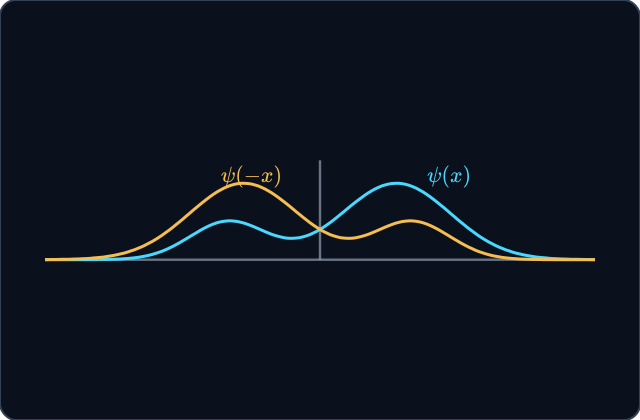
A lopsided state and its mirror image . Their sum is even and their difference is odd, which is how every function splits into an even and an odd part.
The parity operator
reflects through the origin. It squares to the identity, it is both unitary and Hermitian, and it reverses position and momentum.
Properties
- The eigenvalues are : even functions have parity , odd functions . Every function is an even part plus an odd part.
- If then : energy eigenstates can be chosen with definite parity, and parity is conserved.
Parity forbids x between states of equal parity
Write as minus its reflection, , and let each act on the state beside it. The matrix element comes back as minus the product of the two parities times itself; with equal parities that is minus itself, so it is zero.
Proof steps
From .
Substitute.
is Hermitian with real eigenvalues, so it gives on the left and on the right.
Both parities are or both are .
A number equal to minus itself is zero.
Applications
Practice
Plus or Minus One
Reflecting twice gives back the original state, so parity squares to one and its eigenvalues are and : the even and the odd functions.
Try it
What is the parity eigenvalue of ?
Position and Momentum Flip
Under parity both position and momentum change sign: a reflected particle is on the other side and moving the other way.
Try it
What is ?
Even Potentials
If , parity commutes with the Hamiltonian: the kinetic term has , which parity does not change. Energy eigenstates can then be chosen even or odd.
Try it
If , the parity operator commutes with the Hamiltonian.
A Selection Rule
An odd operator such as has zero matrix elements between two states of the same parity. It connects only states of opposite parity.
Try it
Between which pair of states can be nonzero?
Try it
The even part of is . What is its odd part at ? Give three decimal places.
Try it
In any state of definite parity, .
Try it
is odd and is even. What is the parity eigenvalue of the product ?
Final checkpoint
Try it
Which is true of the parity operator?
Try it
In three dimensions parity sends to . What is the parity eigenvalue of ?
Try it
If the Hamiltonian commutes with parity, a state that starts odd can evolve into an even one.
Completion
Lesson complete
Great work! You now know how to:
- find parity eigenvalues of wavefunctions in one and three dimensions
- prove that connects only states of opposite parity
- decide when parity is conserved