Intuition
A pair of coordinates is not a pair of labels. It is a pair of instructions: stretch this arrow by so much, stretch that one by so much, and add whatever you get.
Linear Algebra · Lesson 02
A pair of coordinates is not a pair of labels. It is a pair of instructions: stretch this arrow by so much, stretch that one by so much, and add whatever you get.
Read freely. Sign in when you want to save your place.
Sign in to save progressA pair of coordinates is not a pair of labels. It is a pair of instructions: stretch this arrow by so much, stretch that one by so much, and add whatever you get.
A recipe saying two and three means nothing until the cup and the spoon are fixed. The numbers are the amounts; what they measure out decides what arrives.
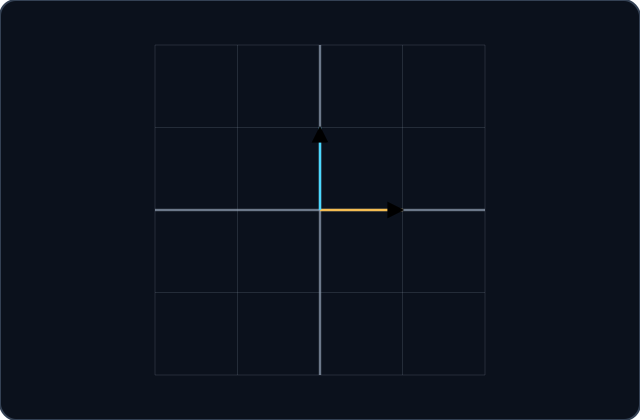
Two arrows are singled out: one step to the right, one step up. They are written and , and they are the whole of what the coordinate system is.
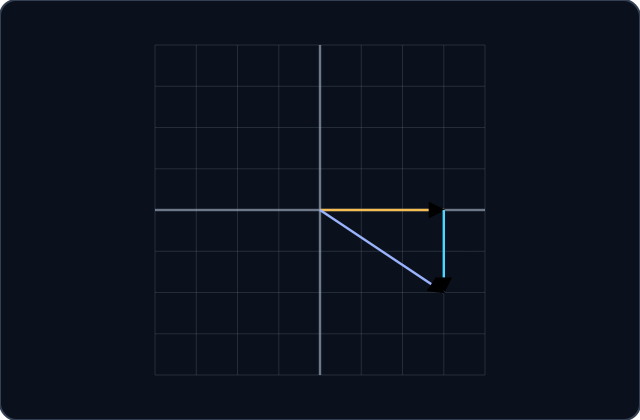
So is an instruction: stretch by three, flip and stretch it by two, then add. The green arrow is what arrives.
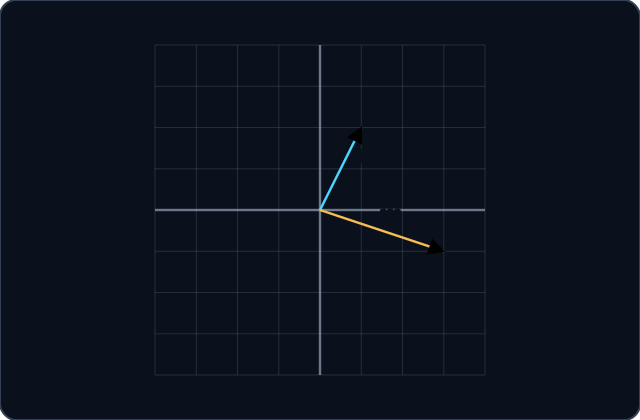
Nothing obliges the two arrows to be the unit ones. Scale this pair by three and by instead and the same two numbers name a different place. The plane has not changed; what the numbers were told to scale has.
Scaling two vectors and adding the results is a linear combination of them, and the two numbers doing the scaling are its scalars. The pair being scaled is a basis, and a vector’s coordinates are exactly the scalars that basis needs in order to reach it. Everything reachable this way — every place a free choice of two scalars can put you — is the span of the pair. The word linear is there because scaling one vector on its own traces a straight line through the origin, so a combination of two is a way of joining two lines.
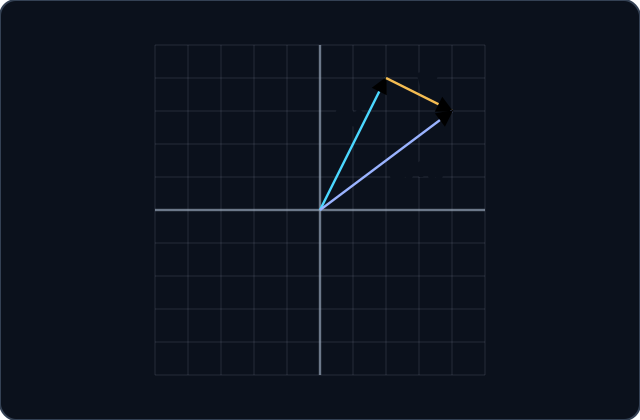
One combination of and , with and . Turning the two scalars freely moves the green tip, and everywhere it can be sent is the span.
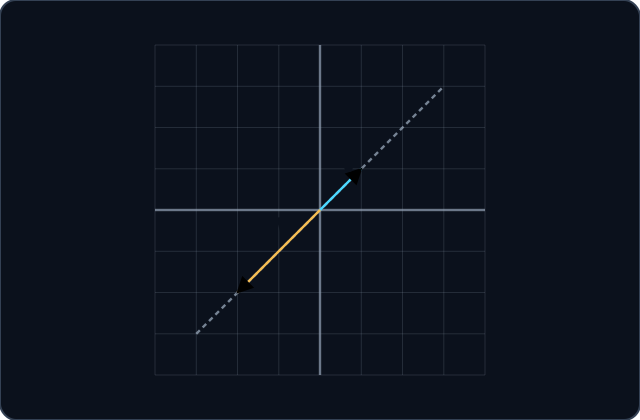
Here , so every combination is a multiple of and lands on the dashed line. The pair is linearly dependent: drop either one and the span is the same.
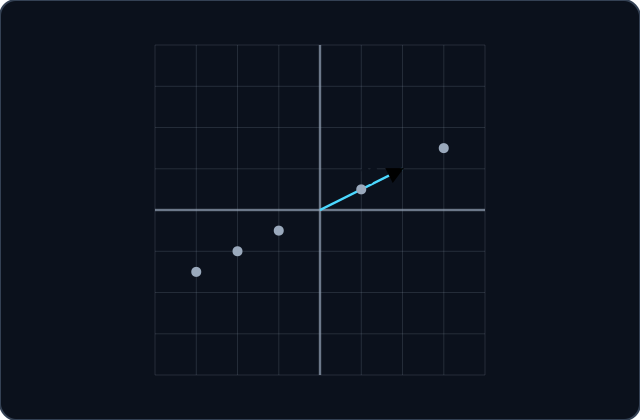
The multiples of , drawn as the points at their tips. A single vector is an arrow; a collection of them is easier to read once the arrows are left out.
Take any vector at all. From its tip, walk backwards along ; letting the length of that walk vary traces a whole line parallel to . The multiples of trace another line, and the two are not parallel, so they cross exactly once. The walk that reaches the crossing fixes , what is left over is a multiple of and fixes , and putting the two back together is .
Scaling on its own sweeps out a line through the origin. Call it .
From the tip of , walk backwards along . Letting vary traces a line parallel to .
That line and are not parallel, because and are not, so they meet at exactly one place. Meeting it is this condition, and it fixes a single .
Being on means what is left after the walk is some multiple of , and that fixes a single .
Add the walk back. Every in the plane has been written as a combination, so the span is the whole plane.
Four steps in the direction of , then three in the direction opposite to .
Try it
In the usual coordinate system, what is the in doing?
The scalars and against this basis reach a different vector than they would against the unit arrows.
Try it
The same pair of numbers is read against a different pair of basis vectors. What changes?
Whatever the two scalars are, the result is one number times the first arrow.
Try it
Two arrows in the plane lie along the same line through the origin. Drawn as the points at their tips, what does their span look like?
When this can be solved, is already on the sheet and adds nothing to the span.
Try it
In three dimensions and are not parallel, and lies on the flat sheet they span. What is the span of all three?
Try it
A list of vectors is linearly dependent. Which statement says the same thing?