An instruction to move.
Imagine giving someone directions on a blank map: move three units to the right, then two units up. You have not named a place. You have described a movement. A vector captures that movement as a single object.
Linear Algebra · Lesson 01
See how an arrow, a displacement, and a pair of coordinates describe the same idea.
Read freely. Sign in when you want to save your place.
Sign in to save progressImagine giving someone directions on a blank map: move three units to the right, then two units up. You have not named a place. You have described a movement. A vector captures that movement as a single object.
Draw an arrow from where you start to where you finish. Its direction tells you which way to move; its length tells you how far. The two-step route is useful for measuring the movement, but the vector itself points directly from start to finish.
Choose perpendicular horizontal and vertical axes with the same unit scale. The first component measures the horizontal displacement; the second measures the vertical displacement. Positive means right or up, negative means left or down.
The column is a compact description of the arrow, not a second kind of object. Read it from top to bottom: horizontal, then vertical. These components depend on the coordinate system we chose; a different basis can give the same geometric vector different coordinates.
The horizontal and vertical legs form a right triangle. The arrow is its hypotenuse, so the Pythagorean theorem gives its magnitude. Adding the components would measure the two-leg route instead of the straight-line displacement.
Now start away from the origin. To find the displacement, subtract the starting coordinates from the ending coordinates. The vector records the change in position, not the endpoint by itself.
Worked example
Subtract start from finish, one coordinate at a time.
The resulting vector is identical to the one drawn at the origin. Translating an arrow does not change its displacement.
An arrow and its coordinates are two views of one idea. Place two movements tip to tail and you begin to see vector addition. Stretch a movement and you begin to see scalar multiplication. Those are the next ideas this foundation makes possible.
Three groups of people mean three different things by the word vector: an arrow with a length and a direction, an ordered list of numbers, or anything at all that can be added and scaled. The subject lives in the translation between them.
A temperature can be given in Celsius or in Fahrenheit. Neither number is the temperature; each is a way of naming it, and knowing how to move between them is worth more than either alone.
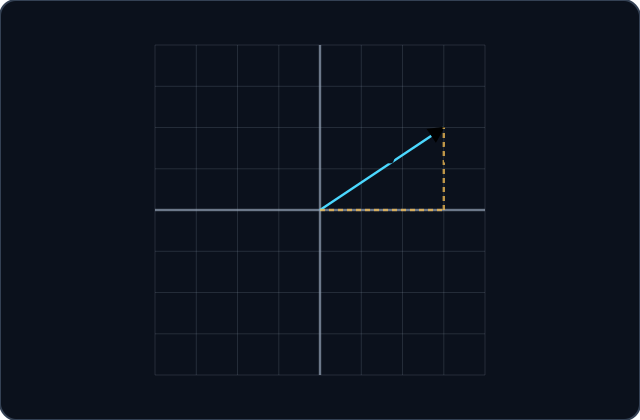
The arrow comes first; the two numbers are read off it afterwards. Three across, then two up — that walk is what records.
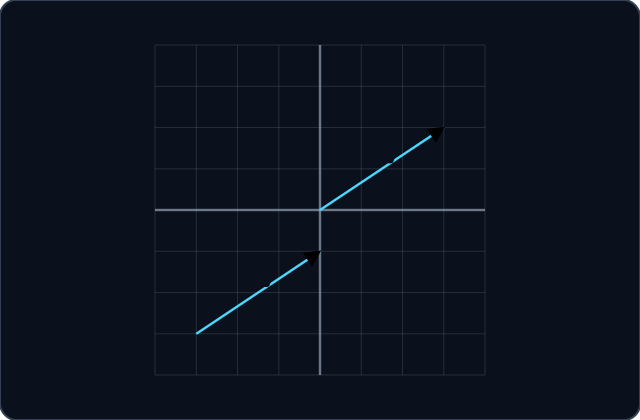
Same length, same direction, so to a physicist these are one vector. We still draw every arrow from the origin, because that is what gives each one a single pair of numbers.
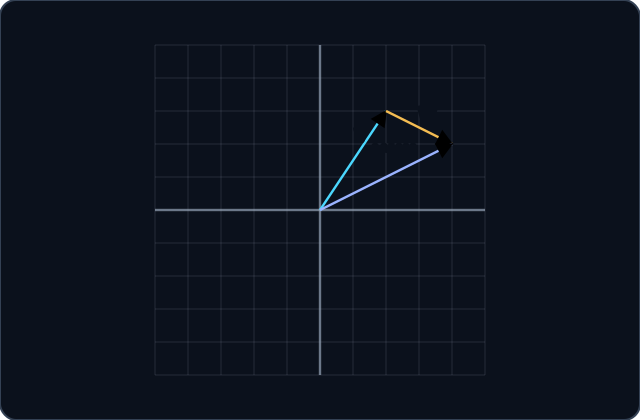
Walk along , then along from where you stopped. The single arrow reaching the same place is their sum, and its numbers are the two walks added position by position.
The physicist says a vector is an arrow: what fixes it is a length and a direction, and sliding it about changes nothing. The computer scientist says a vector is an ordered list of numbers, and its dimension is how long the list is. The mathematician keeps only what both have in common — that two vectors can be added and that a vector can be scaled by a number — and asks nothing else. The whole of this course is the translation between the first two, with the third waiting at the end.
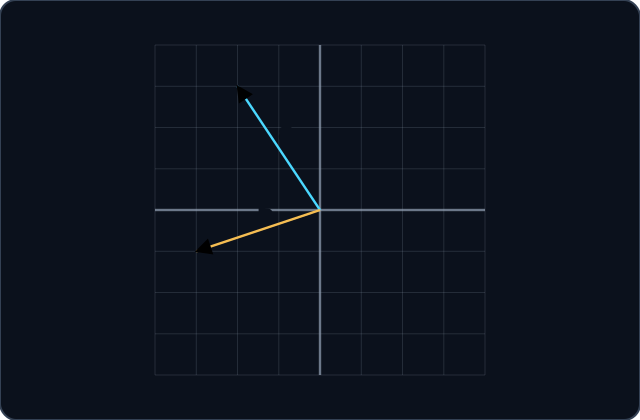
A negative first coordinate walks left, a negative second walks down. Here is two left and three up, and is three left and one down.
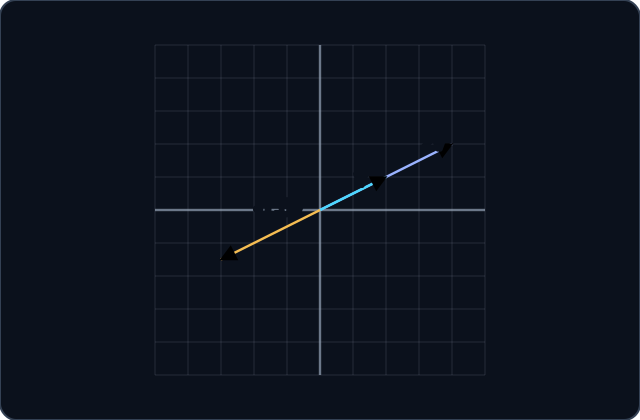
Scaling stretches, squashes, and with a negative number turns the arrow round. The direction it lies along never changes, which is the whole of what a scalar does.
One is one across and four up; the other is four across and one up.
Try it
Which arrow does describe?
the walk from to
Three across and two up, the same walk as from the origin to .
Try it
An arrow runs from to . Which vector is it?
A list to a computer, an arrow to an eye, and the same vector to both.
Try it
A dataset gives each house a floor area and a price. Is a house a vector?
the arrow to that point
No other pair reaches it, and it reaches no other pair.
Try it
How many different pairs of numbers describe one arrow drawn from the origin?
Try it
The mathematician says a vector is anything that can be added and scaled. What should be made of that here?
Try it
The vector v has components (3, 2). What is its magnitude?
Try it
P = (1, 1) and Q = (4, 3). Which vector represents Q − P?