Math Infinitum
Mapping the lesson.
Loading the workspace…
Linear Algebra · Lesson 03
An expression in which every term has degree two, such as three x squared plus two x y plus three y squared, is a quadratic form. The cross term makes it hard to read, but turning the axes onto the eigenvectors of its symmetric matrix removes the cross term, and what is left shows at once its sign, its largest and smallest values and the shape of its level curves.
Read freely. Sign in when you want to save your place.
Sign in to save progressAn expression in which every term has degree two, such as three x squared plus two x y plus three y squared, is a quadratic form. The cross term makes it hard to read, but turning the axes onto the eigenvectors of its symmetric matrix removes the cross term, and what is left shows at once its sign, its largest and smallest values and the shape of its level curves.
A hill seen from the wrong side looks lopsided, but walk round to face it squarely and it is a simple mound with a steep direction and a gentle one. The eigenvectors are the direction to face it from.
A quadratic form on is with symmetric; the coefficient of a cross term is shared equally between and . The form is positive definite when for every , negative definite when , and indefinite when it takes both signs. The theorem below, the principal axes theorem, decides all of this from the eigenvalues.
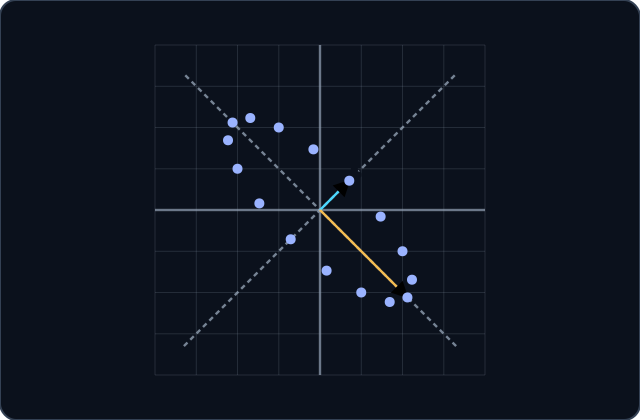
Points of the curve . Its matrix has eigenvalues and with eigenvectors along and . In those axes the curve is : an ellipse with half-axis along and along .
Diagonalise by the spectral theorem and substitute. With , the coordinates of in the orthonormal basis of eigenvectors, the form becomes , and a diagonal matrix leaves only squares. The new axes are rotated or reflected, never stretched, because is orthogonal.
The spectral theorem.
Substitute for .
Name the new coordinates: the coordinates of in the orthonormal basis of eigenvectors.
A diagonal matrix leaves only the squares, each weighted by its eigenvalue.
Put the coefficients of the squares on the diagonal and split each cross term's coefficient in half between the two mirror positions.
Try it
Which symmetric matrix gives ?
Try it
with . What is ?
In the principal axes the form is . It is positive for every non-zero input exactly when every is positive.
Try it
Which quadratic form is positive definite?
Try it
What is the largest value of on the unit circle ?
Try it
A quadratic form whose symmetric matrix has the eigenvalues and takes both positive and negative values.
Try it
What is the curve ?
Try it
In its principal axes the curve becomes . How long is its longer half-axis?
Try it
If every diagonal entry of a symmetric matrix is positive, its quadratic form is positive definite.
Try it
Which symmetric matrix gives ?
Try it
What is the smallest value of on the unit circle?
Try it
for every matrix and every vector .
Great work! You now know how to: