Intuition
A linear map on all of a space is already decided by what it does to a handful of vectors. Knowing where each of them goes is enough to know where everything goes.
Knowing the price of one unit of each product fixes the bill for every possible order. Nothing else about the order has to be looked up.
Standard vectors and the matrix
Write for the vector of with 1 in position j and 0 elsewhere. Every vector is the combination of them, with its own components as the weights. The matrix of a linear map is built by putting the images of the standard vectors in as columns.
How to use it
- for every of .
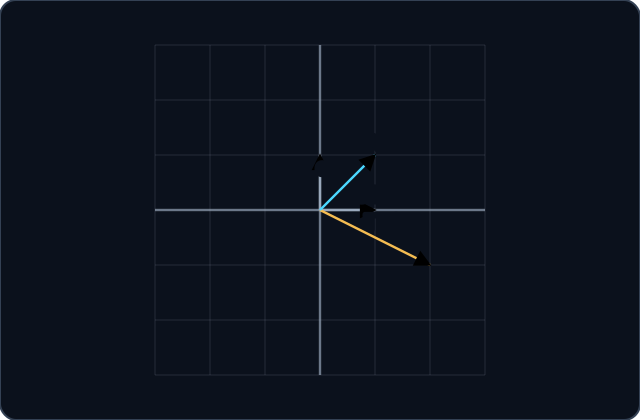
Feed the map the two standard vectors and watch where they land. Those two answers, written side by side as columns, are the whole matrix — and nothing else about the map has to be looked up, because every other vector is a combination of and .
Every linear map is a matrix
Write the incoming vector as the combination of the standard vectors with its own components as weights. Linearity carries the map inside that combination, leaving the same weights on the images. Those images are the columns of the matrix, so what is left is precisely the product of the matrix and the vector.
Proof steps
Every vector is this combination of the standard vectors, with its own components as the weights.
Apply the map to that expression, which is only rewriting what it was given.
Linearity passes the map through the combination and leaves the weights untouched.
Name the matrix whose columns are exactly those images.
The previous line is a weighted sum of the columns of that matrix, which is the definition of the product.
Applications
Practice
Feed it the standard vectors
,
The matrix has first column and second column .
Try it
A linear map has and . What is its matrix?
The shape follows the two spaces
has a matrix
Four columns, each of length two.
Try it
is a linear map from to . What shape is its matrix?
The standard vectors decide everything
Nothing else about is needed.
Try it
Two linear maps from agree on and on . What follows?
Reading the map back out
sends to
Straight off the first column.
Try it
Let . Where does the map send ?
Try it
A linear map has and . What is ?