Intuition
A map takes a vector and returns a vector. It is called linear when it respects the two operations: adding first and mapping gives the same as mapping first and adding, and the same for scaling.
Converting a price list to another currency is linear. Two orders converted separately and then added cost the same as the orders added and then converted.
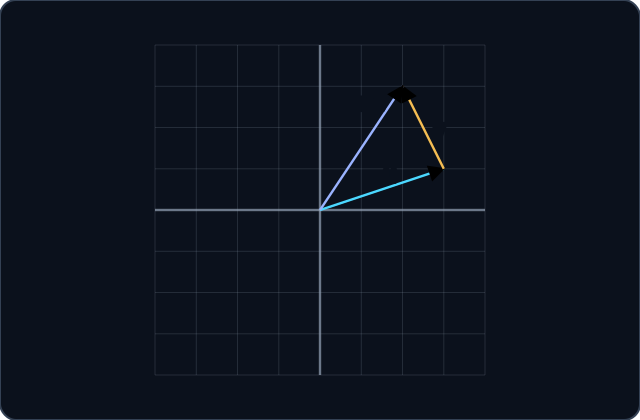
Before the map: two vectors and their sum, walked tip to tail.
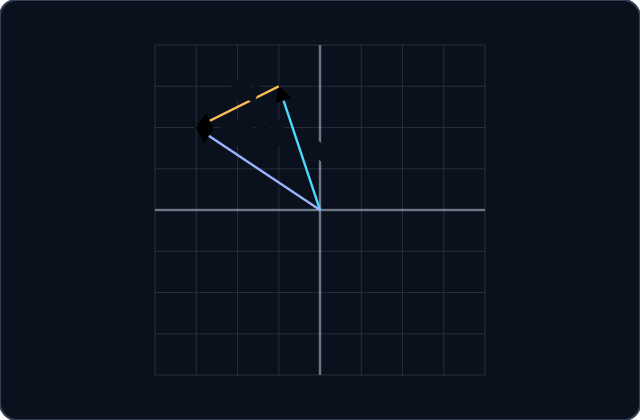
After a quarter turn. The whole triangle has turned with the plane, so the arrow that was the sum is still the sum: mapping then adding and adding then mapping arrive at one place. A map for which this fails, however sensible it looks, is not linear.
Maps that respect the operations
A map from to is linear when it satisfies both conditions below for every pair of vectors and every scalar. Both are needed: a map may respect one and break the other. Squaring each component respects neither, and adding a fixed non-zero vector respects neither.
Immediate consequences
- : take in the second condition.
- A map with is therefore not linear, whatever else it does.
Every matrix gives a linear map
Unfold both sides using the definition of the product as a weighted sum of columns. Adding two vectors adds their weights position by position, and the rule for scaling by a sum turns the pair of terms on each column into one. Scaling a vector multiplies every weight, which the rule for scaling a combination hands straight back out.
Proof steps
Unfold the product: the weight on column j is component j of , which is .
Each term splits by the rule for scaling by a sum, from the lesson on adding and scaling vectors.
Gather the terms carrying and those carrying ; each group is a product by definition.
Scaling the vector multiplies every weight by c, and c comes back out of the whole combination.
Both required conditions hold for every and every c, which is the definition.
Applications
Practice
Two conditions, both required
and
Neither line implies the other, so neither may be skipped.
Try it
What must a map satisfy to be called linear?
Shifting is not linear
gives
With the zero vector has moved, so is not linear.
Try it
Is linear?
Fixing zero is not enough
gives
Doubling the input should double the output, and it quadrupled the first component.
Try it
Is linear?
Linearity passes through combinations
Split the sum with the first condition, then pull out each scalar with the second.
Try it
is linear, and . What is ?
Try it
Which of these maps from to is linear?