Math Infinitum
Mapping the lesson.
Loading the workspace…
Topology · Lesson 01
Two spaces can be combined into one whose points are pairs. The set is the Cartesian product, familiar from coordinates in the plane, and it comes with two maps that read off a coordinate. What it does not come with is a topology: that has to be chosen, and the choice is the subject of this chapter.
Read freely. Sign in when you want to save your place.
Sign in to save progressComplete Chapter practice first.
Two spaces can be combined into one whose points are pairs. The set is the Cartesian product, familiar from coordinates in the plane, and it comes with two maps that read off a coordinate. What it does not come with is a topology: that has to be chosen, and the choice is the subject of this chapter.
A seat in a theatre is a row and a number. The seating plan is the product of the two lists, and the two ushers who read off row and number are the projections.
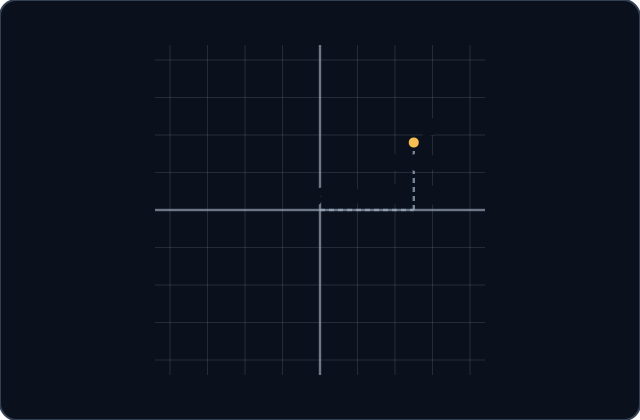
A point of is a pair, and the two projections read off its coordinates: is where it stands on the first axis and where it stands on the second. The set is settled; which subsets count as open is not.
For sets and , the Cartesian product is the set of ordered pairs with and . It carries two projection maps, and . A subset of the form is called a box; not every subset of a product is one.
Both sides are sets of pairs, so the proof reads each side at a single pair. A pair lies in the left-hand side when it lies in both boxes, which says its first coordinate is in A and in C and its second is in B and in D. That is exactly the condition for lying in the right-hand side. Nothing is used beyond the definition of a box and of an intersection, which is why this identity holds for any sets at all.
Take a pair in the intersection of the two boxes.
Membership of a box is a condition on each coordinate, so there are four conditions.
Group the two conditions on the first coordinate and the two on the second.
That is membership of the box on the right, and every step is reversible.
The product is the set of pairs; the projections read off a coordinate.
Try it
What is ?
Try it
The diagonal is a box .
Try it
What is ?
Try it
A union of two boxes is a box.
Try it
has points and has . How many points has ?
Try it
When is the projection onto?
Try it
When is injective?
Try it
Which subset of is a box?
Try it
The Cartesian product of two topological spaces comes with a topology automatically.
Great work! You now know how to: