Math Infinitum
Mapping the lesson.
Loading the workspace…
Topology · Lesson 05
Two spaces are the same, topologically, when there is a bijection between their points that matches their open sets exactly. Such a map is a homeomorphism, and it is the right notion of sameness here: it is continuous in both directions, so nothing stated in open sets can tell the two spaces apart.
Read freely. Sign in when you want to save your place.
Sign in to save progressTwo spaces are the same, topologically, when there is a bijection between their points that matches their open sets exactly. Such a map is a homeomorphism, and it is the right notion of sameness here: it is continuous in both directions, so nothing stated in open sets can tell the two spaces apart.
A cup and a doughnut are the same shape to a topologist because one can be moulded into the other without tearing or gluing. The moulding is the map; being able to mould back is what makes it an equivalence.
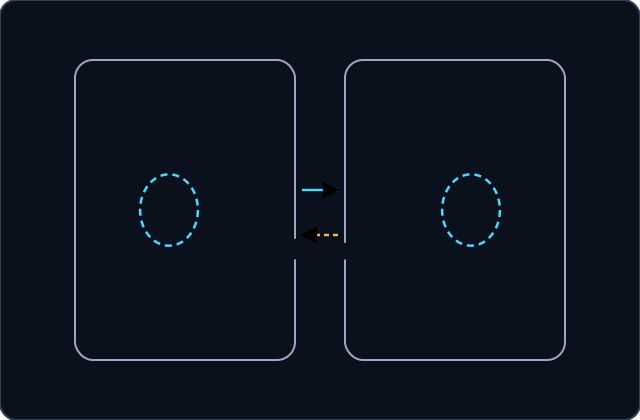
A homeomorphism matches the topologies: is open exactly when is. Both maps are continuous, so open sets travel in both directions, and any statement made only about open sets holds in one space exactly when it holds in the other.
A homeomorphism is a bijection such that both and are continuous. Two spaces are homeomorphic, written , when one exists. Being homeomorphic is an equivalence relation: the identity is a homeomorphism, an inverse of one is one, and a composition of two is one.
For a bijection the preimage of a set under the inverse map is the image of that set under the map itself. So asking the inverse to be continuous — preimages of open sets open — is asking images of open sets under the original map to be open, which is what being an open map means. The whole content is the identity between the image under one map and the preimage under the other, which holds only because the map is a bijection.
For a bijection, pulling back along the inverse is pushing forward along the map.
Write out what continuity of the inverse means, using the definition on the inverse map.
Substitute the identity from the first step.
That is precisely the definition of an open map, so the two conditions agree.
A homeomorphism is a bijection that is continuous and whose inverse is continuous. Both halves are needed.
Try it
What is a homeomorphism?
Try it
Which map is a continuous bijection that is not a homeomorphism?
Try it
and are homeomorphic.
Try it
A continuous bijection is a homeomorphism exactly when it is also:
Try it
Up to homeomorphism, how many topological spaces have exactly two points?
Try it
Being homeomorphic is an equivalence relation on spaces.
Try it
Why is the Sierpiński space not homeomorphic to the two-point discrete space?
Try it
Which pair of subspaces of is homeomorphic?
Try it
Which statement is true?
Try it
If and is bounded as a metric space, then is bounded too.
Great work! You now know how to: