Intuition
Each member of an ensemble obeys Schrödinger’s equation, so the density matrix obeys , the von Neumann equation. In the energy basis the populations stay as they are and the coherences turn at the Bohr frequencies. The evolution is unitary, , so the eigenvalues of , its purity and every measure of how mixed it is stay the same: an isolated system never becomes more or less mixed. A density matrix that does not change commutes with . The thermal state, which describes a system in equilibrium with surroundings at temperature , is one: its populations fall off as , and it has no coherences between energy levels.
A troupe of dancers following one choreography: the pattern on the floor turns and shifts, but how the dancers are spread among the steps never changes. Isolated evolution moves a mixture without mixing it further.
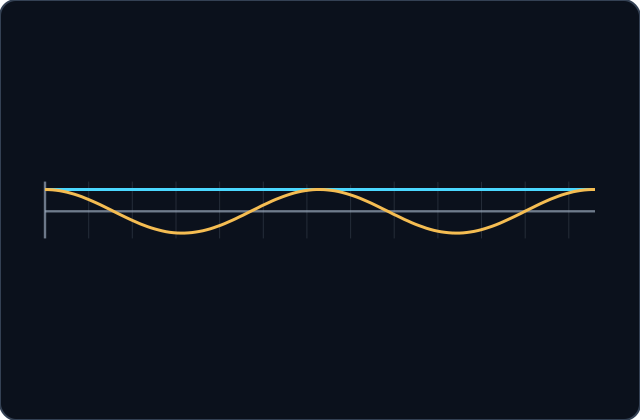
A spin in a field along , started in , with time in units of . The population of the upper level stays at , while the real part of the coherence turns at the Bohr frequency : the Bloch vector precesses about the field.
The von Neumann equation
For a system with Hamiltonian and evolution operator :
Properties
- In the eigenbasis of : is constant and , with .
The von Neumann equation
Differentiate the projector of one member by the product rule. Schrödinger’s equation gives the derivative of the ket, and its adjoint the derivative of the bra, with the opposite sign. Together they make the commutator with , and the weights , which do not change, carry it to the whole ensemble.
Proof steps
The product rule.
Schrödinger’s equation and its adjoint; is Hermitian.
Multiply the product rule by and substitute.
Collect the two terms.
The weights are constant and the commutator is linear.
Applications
Practice
The von Neumann Equation
Every member of an ensemble obeys Schrödinger’s equation, and together they make the density matrix change by its commutator with the Hamiltonian.
Try it
Which equation does a density matrix obey under a Hamiltonian ?
Populations Stay
In the basis of energy eigenstates the von Neumann equation leaves every diagonal element of unchanged.
Try it
A spin has in the energy basis and evolves for a long time under its own Hamiltonian. What is then?
No More Mixed
Unitary evolution is a change of basis in time: it keeps the eigenvalues of , and with them the purity.
Try it
An isolated system evolving under its own Hamiltonian can go from a pure state to a mixed one.
Coherences Turn
In the energy basis each coherence keeps its size and turns its phase at the Bohr frequency of its two levels.
Try it
Two levels are 2 eV apart. With eV fs, what is the period of their coherence, in fs? Give two decimal places.
Try it
Which density matrices stay constant in time?
Try it
The thermal state has no coherences between different energy levels.
Try it
A spin in a field has two levels eV apart, at a temperature where eV. In the thermal state, what is the population of the upper level divided by that of the lower? Give three decimal places.
Final checkpoint
Try it
How does the von Neumann equation differ from Heisenberg’s equation for an observable?
Try it
Unitary evolution changes the eigenvalues of .
Try it
What does the thermal state of a spin become as the temperature grows without bound?
Completion
Lesson complete
Great work! You now know how to:
- derive the von Neumann equation from Schrödinger’s
- say what isolated evolution changes and what it keeps
- write the thermal state and its populations