Intuition
Any basis can be straightened into an orthogonal one. Keep the first vector; from the second, remove its projection onto the first; from the third, remove its projections onto the two already made; and so on. What is left each time is at right angles to everything before it.
Building a staircase against a sloping wall, each new step is trimmed where it would lean into the steps already laid, so that every step sits square to the ones below.
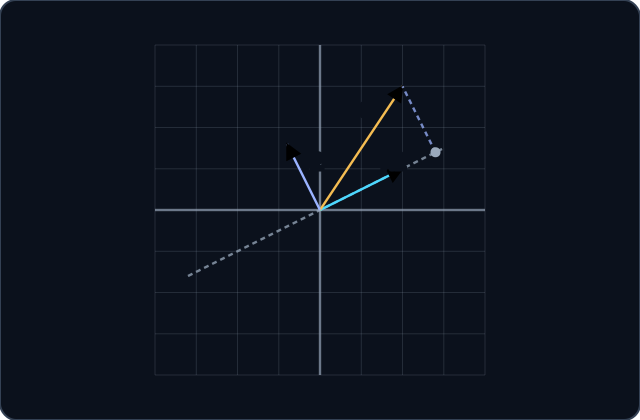
One step of Gram–Schmidt. The projection of onto is . What is left, , is perpendicular to , and with it spans the same plane as .
The process
Start from independent vectors . Put , and for each later subtract from its projections onto the vectors already made. The are orthogonal, and dividing each by its length makes them orthonormal. It works with any inner product in place of the dot product.
What it gives
- At every stage : the theorem below.
Gram–Schmidt keeps the span
Go one step at a time. The new vector is orthogonal to the earlier ones, because subtracting the projection onto removes exactly the part along , and the earlier are orthogonal to each other. It lies in the span of , and it is not zero, since otherwise would be a combination of the earlier . So there are orthogonal non-zero vectors, which are independent, inside a space of dimension : they span it.
Proof steps
The first vector is kept.
For , the earlier are orthogonal to one another, so only one term of the sum survives the dot product, and it cancels.
is minus a combination of earlier , which are combinations of the earlier .
If it were , would be a combination of , against independence.
orthogonal non-zero vectors are independent, and inside a space of dimension they span it.
Applications
Practice
One Step
To make orthogonal to , subtract its projection onto .
Try it
Gram–Schmidt is applied to , . What is ?
Try it
Gram–Schmidt on , , gives , a multiple of , and a multiple of . What is ?
Try it
Gram–Schmidt applied to the same vectors in a different order gives the same orthogonal basis.
Try it
Gram–Schmidt applied to produces . What does that show?
Orthonormal at the End
Divide each vector of the orthogonal basis by its own length. Directions and orthogonality are unchanged; every length becomes 1.
Try it
Gram–Schmidt gives the orthogonal vectors and . Which orthonormal pair has the same span?
Try it
Gram–Schmidt is applied to , . What is the first component of ? Give a decimal.
Try it
After two steps of Gram–Schmidt, and span the same subspace as and .
Try it
has independent columns, and Gram–Schmidt on them gives . What kind of matrix is ?
What You Learned
- is minus its projections onto the earlier .
Final checkpoint
Try it
Gram–Schmidt is applied to , . What is ?
Try it
, and is made from by Gram–Schmidt. What is ?
Try it
Every subspace of other than has an orthonormal basis.
Completion
Lesson complete
Great work! You now know how to:
- run the Gram–Schmidt process on a list of vectors;
- normalise to an orthonormal basis;
- recognise dependence when a vector comes out zero;
- connect the process with .