Math Infinitum
Mapping the lesson.
Loading the workspace…
Linear Algebra · Lesson 03
When a column has no pivot, its unknown is free: it can take any value, and the other unknowns follow from it. Each free unknown is a direction along which the solutions stretch, so one gives a line of solutions and two give a plane.
Read freely. Sign in when you want to save your place.
Sign in to save progressWhen a column has no pivot, its unknown is free: it can take any value, and the other unknowns follow from it. Each free unknown is a direction along which the solutions stretch, so one gives a line of solutions and two give a plane.
A recipe for a blend fixes some amounts once others are chosen. The free ones are the choices you are allowed; everything else is forced by them.
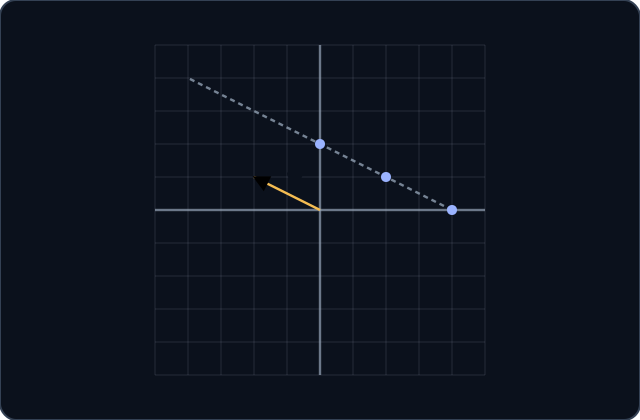
The solutions of , one equation in two unknowns. With free, , so every solution is with and : the point moved along the direction . One free unknown, one line.
After elimination, an unknown whose column holds a pivot is a basic variable, and every other unknown is free. If the system is consistent, the free variables may take any values, and back substitution expresses each basic variable through them. Collected into one vector, the result is the parametric form of the solutions: a particular solution plus a combination of fixed vectors, one for each free variable.
Subtract the two equations: , and . So every solution is plus a solution of the homogeneous system, and every such sum is a solution.
Fix one particular solution .
A matrix distributes over a difference of vectors.
If is a solution too, the difference solves the homogeneous system: .
Conversely, plus any homogeneous solution solves the system.
The solution set is one particular solution moved by every solution of the homogeneous system.
Look at the echelon form. Unknowns whose columns hold pivots are basic; the rest are free.
Pivots in columns 1 and 3: and are basic, and are free. Then and .
Try it
A system in reduces to . Which variables are free?
Try it
A consistent system in unknowns has an echelon form with pivots. How many free variables does it have?
Try it
What are the solutions of the single equation in the unknowns ?
Try it
A system reduces to . What follows?
Try it
A linear system can have exactly two solutions.
Try it
The solutions of a system are for all real . What is in the solution with ?
Try it
A homogeneous system with more unknowns than equations has a non-zero solution.
Try it
solves and solves . What does solve?
Try it
The system , has infinitely many solutions. Which is a direction vector of its solution set?
Try it
A system in three unknowns reduces to . How many solutions does it have?
Try it
A consistent system of equations in unknowns has pivots. How many free variables does it have?
Try it
If an echelon form of a system has a column without a pivot, the system has infinitely many solutions.
Great work! You now know how to: