Intuition
Three words build every compound statement: and, or, not. You already met them as set operations. Intersection is "and", union is "or", and complement is "not". The one word that behaves differently from everyday speech is "or", which in mathematics never excludes the case where both parts hold.
A menu offering soup or salad usually means one of the two. Mathematics reads the same word as a doorman checking a guest list: you may enter if your name is on the first list or on the second, and being on both is no reason to turn you away.
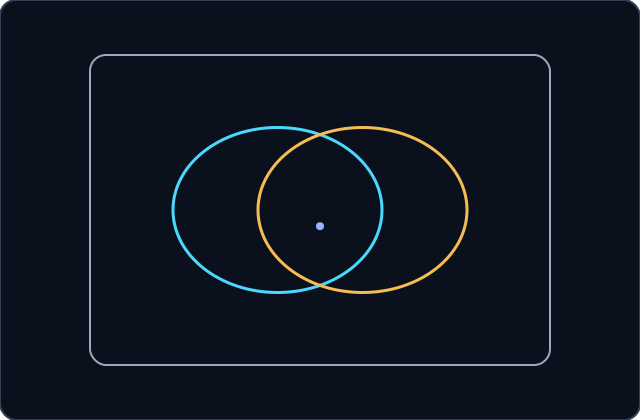
The three words are the three set operations under different names: "and" is the overlap, "or" is everything inside either ring, and "not " is the whole frame outside . The surprising one is "or", which in mathematics always keeps the overlap.
The three connectives
A truth table lists every combination of truth values for the parts and records the value of the whole. Two statements built from the same parts are equivalent when their tables agree line by line.
How each one behaves
- is true exactly when both and are true.
- is true exactly when at least one of them is true, and that includes both.
- is true exactly when is false.
De Morgan's law for statements
Both sides say the same thing: the pair fails. Splitting into the case where both parts are true and the case where at least one fails settles every line of the truth table at once.
Proof steps
Take the first case, where the pair does hold.
Here is true, so its negation is false.
Both negations are false, and a disjunction of two false parts is false. The sides agree.
This single case covers the three remaining lines of the table.
A conjunction needs both parts, so one failure makes it false and its negation true.
The part that failed has a true negation, and a disjunction needs only one. The sides agree again.
Applications
Practice
:::note{title="Mathematical "or" includes both"} A disjunction asks for at least one part to hold. It is satisfied, not spoiled, when both parts hold. :::
Mathematical "or" includes both
Let be and be . Then is true.
Both parts are true, and that still counts: a disjunction needs at least one.
Try it
Let be and be . Both are true. What is the value of ?
A conjunction needs every part
Let be and be . Then is false.
fails, and a conjunction cannot survive a single failure.
Try it
Let be and be . What is the value of ?
Negating a conjunction
The "and" turns into an "or" as the negation moves inward. Compare it with the set law you already proved.
Try it
Which statement is equivalent to ?
The same idea in two notations
Intersection is the conjunction of two membership statements, which is why their laws match.
Try it
Which connective corresponds to the union ?
Try it
Which statement is equivalent to ?
Or Includes Both
Everyday speech often means one or the other but not both. Mathematics never does unless it says so.
Try it
Let be " is even" and be " is a square". Both are true. What is the value of ?
Try it
Which statement is equivalent to ?
Try it
and always have the same truth value.
Try it
A truth table for a compound statement in separate statements has how many rows?
What You Learned
- needs both; needs at least one, including both.
- De Morgan: is , and is .
Final checkpoint
Try it
is true and is false. What is the value of ?
Completion
Lesson complete
Great work! You now know how to:
- Compute the value of a compound statement from the values of its parts
- Apply both De Morgan laws to statements
- Read the mathematical "or" as inclusive